


Diana Atehortúa Alonso

Edward Gómez

Marco Andrés Pico Herrera
Johan Nicolás Fuquene Sierra

Universidad Externado de Colombia

Gustavo A Yepes López


Keep this story going! Share below!
In Colombia, according to Asograsas, about 621,000 tons of edible vegetable oil are consumed per year — Oleorevista estimates approximately 350 million liters annually — and according to ANDI, nearly a third becomes waste. According to the Universidad Nacional de Colombia, Bogotá alone generates more than 35,000 tons of used vegetable oil per year. That oil is not collected by garbage trucks, and when disposed of improperly, it causes double damage.
The first is environmental: according to Fundación Aquae, one liter of oil can contaminate up to 1,000 liters of water. When it reaches water sources, it forms a film that prevents the passage of oxygen and light, clogs the sewage system, and overloads wastewater treatment plants, as recognized by Colombia's Ministry of Environment. The second is sanitary and social: the gap in disposal fueled an illegal market where oil is mixed with palm oil and resold for human consumption — prohibited by INVIMA since 2008 — or whitened with chlorine and sodium hypochlorite to return it to the market. According to Asograsas as cited by the company, this illegality accounts for nearly 40% of the national market, and it particularly hits low-income households. (SDG 3)
Benavides points out the cultural bias that sustains this illegal market: "That is something that was instilled in us from a young age, telling us that the more transparent the oil is, the better quality it is. And that is a lie," because that light color is often the disguise of clandestinely recycled oil.
=======================================
En Colombia se consumen alrededor de 621.000 toneladas de aceite vegetal comestible al año (Asograsas, 2016, como se citó en Minambiente, 2018a) —otras fuentes lo estiman en unos 350 millones de litros anuales (Oleorevista, 2024)— y cerca de una tercera parte se convierte en residuo (ANDI, 2017). Solo Bogotá genera más de 35.000 toneladas de AVU al año (Universidad Nacional de Colombia, s.f.). Ese aceite no lo recogen los camiones de basura, y cuando se dispone mal produce un doble daño.
El primero es ambiental: según cifras ampliamente citadas en campañas ambientales, un litro de aceite puede contaminar hasta 1.000 litros de agua (Fundación Aquae, 2021); al llegar a las fuentes hídricas forma una película que impide el paso del oxígeno y la luz, obstruye el alcantarillado y sobrecarga las plantas de tratamiento de aguas residuales (PTAR), como lo reconoce el Ministerio de Ambiente (Minambiente, 2018a). El segundo es sanitario y social: el vacío en la disposición alimentó un mercado ilegal en el que el aceite se mezcla con palma y se revende para consumo humano —prohibido por el INVIMA desde 2008— o se “blanquea” con cloro e hipoclorito de sodio para devolverlo al mercado (Minambiente, 2018a). Según Asograsas (citado por la empresa), esa ilegalidad llega a cerca del 40% del mercado nacional, y golpea sobre todo a los hogares de menores ingresos (ODS 3).
Benavides señala el sesgo cultural que sostiene ese mercado ilegal: “eso es algo que nos inculcaron desde pequeños, diciéndonos que el aceite, entre más transparente sea, es de mejor calidad. Y eso es mentira”, porque ese color claro suele ser el disfraz de un aceite reciclado de forma clandestina.
GreenFuel's innovation is an integrated, certified circular economy model that turns waste without a legal destination into a sustainable, traceable, and exportable commodity.
In practice, the company collects, certifies, treats, and exports used vegetable oil from fryers in restaurants, hotels, industries, and homes. It homogenizes it at its Soacha plant until it becomes a sustainable biomass that meets the characteristics of a commodity (acidity, moisture, impurities, phosphorus, iodine, and sulfur indices), and exports it to its partner Green Fuel Extremadura in Spain, which performs the final transesterification and converts it into second-generation biodiesel.
The model is supported by four decisions that distinguish it from a simple collection service: (1) it created a market where none existed, to the point of promoting the regulation that ordered the sector, Agreement 634 of 2015 of the Bogotá Council; (2) it inverted the economic equation for the client: the oil stopped being a problem and became an income — GreenFuel pays for it — and a valid environmental certificate to comply with Resolution 0316 of 2018 of the Ministry of Environment; (3) it certifies complete traceability under the European ISCC seal, "from the moment it is collected in the restaurants until it becomes second-generation diesel"; and (4) it integrated the entire operation into its own platform with a routing app that organizes frequencies, weighs and certifies on-site, and controls inventory up to the plant.
The model delivers clear advantages: second-generation biodiesel reduces emissions by up to 92% compared to fossil diesel, according to the company's ISCC certification, well above the approximately 75% of first-generation biodiesel derived from palm. It does not compete with food production, and the certification opens demanding export markets. The key turn is stated by the CEO himself: "we pay for the oil that we collect at each of the points."
=======================================
La innovación de GreenFuel consiste en un modelo de economía circular integrado y certificado que convierte un residuo sin destino legal en un commodity sostenible, trazable y exportable.
En la práctica, la empresa recolecta, certifica, trata y exporta el aceite vegetal usado que sale de las frituras de restaurantes, hoteles, industrias y hogares: lo homogeniza en su planta de Soacha hasta convertirlo en una biomasa sostenible que cumple las características de un commodity (acidez, humedad, impurezas, índices de fósforo, yodo y azufre), y lo exporta a su aliado Green Fuel Extremadura (España), que realiza la transesterificación final y lo convierte en biodiésel de segunda generación.
El modelo se apoya en cuatro decisiones que lo distinguen de un simple servicio de recolección: (1) creó un mercado donde no existía, al punto de impulsar la regulación que ordenó el sector (Acuerdo 634 de 2015 del Concejo de Bogotá) (Concejo de Bogotá, 2015); (2) invirtió la ecuación económica para el cliente: el aceite dejó de ser un problema y pasó a ser un ingreso —GreenFuel paga por él— y un certificado ambiental válido para cumplir la Resolución 0316 de 2018 del Ministerio de Ambiente (Minambiente, 2018b); (3) certifica la trazabilidad completa bajo el sello europeo ISCC, “desde que se recoge en los restaurantes hasta que se vuelve el diésel de segunda generación”; y (4) integró toda la operación en una plataforma propia con app de ruteo que organiza frecuencias, pesa y certifica en sitio y controla el inventario hasta la planta.
Sus ventajas y beneficios: el biodiésel de segunda generación reduce las emisiones hasta en 92% frente al diésel fósil, según la certificación ISCC de la empresa, muy por encima del ~75% del de primera generación derivado de palma; no compite con la producción de alimentos; y la certificación abre mercados de exportación exigentes. El giro clave lo enuncia el propio CEO: “nosotros pagamos por el aceite que recogemos en cada uno de los puntos”.
It all started with a market study in 2010. Benavides and his partners went restaurant by restaurant to ask what happened to the oil from their fryers, and every finding was worse than the previous one: the myth that it went to the soap industry turned out to be false; part was mixed with palm oil and resold for human consumption (prohibited since 2008); and another part was "whitened" with bleach and caustic soda to return it to the market as new oil. The missing piece was on the other side of the Atlantic: Europe rewarded biodiesel made from waste, but did not collect enough used oil, while Colombia generated it in abundance and wasted it. GreenFuel read that mismatch and built the bridge.
That the system worked was not evident. The first export seems like a comedy: filling the first container took six months of knocking door to door, and when the 22 tons arrived at the port of Cartagena, the anti-narcotics police did not believe the story—they scanned the container nearly twenty times, brought in dogs, and demanded it be transferred: "we don't believe your story that you are exporting oil," they were told. It was, in fact, used cooking oil heading to Europe.
This is how Benavides describes the moment he understood the size of the problem and decided to build a legal alternative: "each of the investigations we did at that time was sadder and more painful than the other".
=======================================
Todo empezó con un estudio de mercado en 2010. Benavides y sus socios fueron restaurante por restaurante a preguntar qué pasaba con el aceite de sus frituras, y cada hallazgo fue peor que el anterior: el mito de que iba a la industria jabonera resultó falso; parte se mezclaba con palma y se revendía para consumo humano (prohibido desde 2008); y otra parte la “blanqueaban” con cloro y soda cáustica para devolverla al mercado como aceite nuevo. La pieza que faltaba estaba al otro lado del Atlántico: Europa premiaba el biodiésel hecho con residuos, pero no recolectaba suficiente aceite usado, mientras Colombia lo generaba en abundancia y lo desperdiciaba. GreenFuel leyó ese desajuste y construyó el puente.
Que el sistema funcionara no era evidente. La primera exportación parece una comedia: llenar el primer contenedor tomó seis meses de tocar puerta por puerta, y cuando las 22 toneladas llegaron al puerto de Cartagena, la policía antinarcóticos no creía el relato —escaneó el contenedor cerca de veinte veces, metió perros y exigió trasvasarlo—: “no te creemos el cuento de que ustedes estén exportando aceite”, les dijeron. Era, en efecto, aceite de cocina usado rumbo a Europa.
Así describe Benavides el momento en que entendió el tamaño del problema y decidió construir una alternativa legal: “cada una de las investigaciones que hicimos en ese momento era más triste y más dolorosa que la otra”.
The innovation contributes directly to five Sustainable Development Goals.
SDG 6 — Clean Water and Sanitation: by collecting used vegetable oil before it reaches the drains, it prevents oil from contaminating water sources and overloading wastewater treatment plants with costly sludge, as recognized by Colombia's Ministry of Environment.
SDG 7 — Affordable and Clean Energy: the collected waste is transformed into second-generation biodiesel, renewable energy from waste.
SDG 12 — Responsible Consumption and Production: the model closes the cycle of used oil in a circular economy, recovering waste that was previously lost or absorbed by the illegal market.
SDG 13 — Climate Action: the resulting biodiesel reduces emissions by up to 92% compared to fossil diesel, according to the company's ISCC certification. According to the Ministry of Environment, each liter of used vegetable oil converted into biodiesel avoids 2.5 kg of CO₂.
SDG 3 — Good Health and Well-Being: by offering a legal and remunerated collection channel, GreenFuel removes raw material from networks that clandestinely recycled oil for human consumption, reducing a real sanitary risk.
For Benavides, the sense of the business is sustained by three pillars: "it is an initiative that has social profitability, environmental profitability, and we seek to have economic profitability." That impact has been recognized with the Colsubsidio Xposible Recognition in the Environmental category in 2023 and a subsequent honorable mention.
=======================================
La innovación contribuye de forma directa a cinco Objetivos de Desarrollo Sostenible.
ODS 6 — Agua limpia y saneamiento: al recolectar el AVU antes de que llegue a los desagües, evita que ese aceite contamine las fuentes hídricas y sobrecargue las PTAR con lodos costosos (Minambiente, 2018a).
ODS 7 — Energía asequible y no contaminante: el residuo recolectado se transforma en biodiésel de segunda generación, energía renovable a partir de un desecho.
ODS 12 — Producción y consumo responsables: el modelo cierra el ciclo del aceite usado en una economía circular, valorizando un residuo que antes se perdía o terminaba en el mercado ilegal.
ODS 13 — Acción por el clima: el biodiésel resultante reduce las emisiones hasta en 92% frente al diésel fósil (ISCC); según el Ministerio de Ambiente, cada litro de AVU convertido en biodiésel evita 2,5 kg de CO₂ (Minambiente, 2018a).
ODS 3 — Salud y bienestar: al ofrecer un canal legal y remunerado, le resta materia prima a las redes que reciclaban aceite de forma clandestina para consumo humano, reduciendo un riesgo sanitario real (Minambiente, 2018a).
Para Benavides, el sentido del negocio se sostiene en tres pilares: “es una iniciativa que tiene una rentabilidad social, una rentabilidad ambiental, y buscamos tener una rentabilidad económica”. Ese impacto ha sido reconocido con el Reconocimiento Xposible de Colsubsidio en categoría Ambiental (2023) y una mención de honor posterior.
GreenFuel receives low-cost waste — it pays little for abundant oil — and sells it as certified raw material in Europe, where regulation mandates the incorporation of increasing percentages of advanced biofuels not derived from food crops, which command a premium over fossil fuel.
The demand not only exists: it is guaranteed by law and is increasing. The European ReFuelEU Aviation mandate requires mixing sustainable aviation fuel in a proportion that rises from 2% in 2025 to 6% in 2030 and up to 70% in 2050, according to the European Union Aviation Safety Agency, and sustainable aviation fuel is currently priced well above fossil kerosene. Signs that the model is viable and growing: more than a decade of operation, ISCC certification since 2013, over 70,000 tons exported, and an expansion underway towards acid esterification — to treat highly degraded oils with acidity from 20% to 80% — and towards the sustainable aviation fuel and marine fuels market, where it is preparing as a supplier of pre-treated raw material.
The CEO himself frames why, beyond the variables that must be managed, it remains a good business: "in the end you have a business that, besides seeking economic profitability, you are contributing a small grain of sand to the environmental part... I think that generates a greater responsibility."
=======================================
GreenFuel recibe un residuo de costo bajo (paga poco por un aceite abundante) y lo vende como materia prima certificada en Europa, donde la regulación obliga a incorporar porcentajes crecientes de biocombustibles avanzados no provenientes de cultivos alimentarios, que pagan una prima sobre el combustible fósil.
La demanda no solo existe: está garantizada por ley y va en aumento. El mandato europeo ReFuelEU Aviation exige mezclar combustible sostenible de aviación (SAF) en una proporción que sube del 2% en 2025 al 6% en 2030 y hasta el 70% en 2050 (EASA, s.f.), y el SAF se cotiza actualmente muy por encima del queroseno fósil. Señales de que el modelo es viable y crece: más de una década de operación, la certificación ISCC desde 2013, más de 70.000 toneladas exportadas y una expansión en marcha hacia la esterificación ácida (para tratar aceites muy degradados, con acidez del 20% al 80%) y hacia el mercado del SAF y los combustibles marinos, donde se prepara como proveedor de materia prima pretratada.
El propio CEO enmarca por qué, más allá de las variables que hay que administrar, sigue siendo un buen negocio: “al final tienes un negocio que, además de buscar una rentabilidad económica, te estás dando un granito de arena importante para la parte ambiental… yo creo que eso genera una responsabilidad mayor”.
GreenFuel has exported more than 70,000 tons of used vegetable oil — approximately 70 million liters. Applying Colombia's Ministry of Environment's factor of 2.5 kg of CO₂ avoided for every liter of used vegetable oil converted into biodiesel, that amount is equivalent to avoiding on the order of 175,000 tons of CO₂. According to Fundación Aquae, one liter of oil contaminates up to 1,000 liters of water, meaning those 70 million liters represent water protected on a huge scale. Added to this is that second-generation biodiesel reduces emissions by up to 92% compared to fossil diesel, according to the company's ISCC certification.
Socially, the model closes the circuit that fueled the illegal market — nearly 40% of the national market according to Asograsas — which affects low-income households above all, who buy repackaged oil "in spoons, in a bag, in a little bottle," without sanitary registration and with serious health risks. In addition, it generates employment through more than 40 direct collaborators and a network of collectors, and raises awareness among households and companies through clean points in residential complexes.
Benavides himself emphasizes the magnitude of the environmental benefit: "if you put the 70,000,000 liters that we have prevented from reaching water sources, that will give you a striking piece of data." And he summarizes the motivation that sustains the project in the message he repeats to his children: "one has to try to be a good person. And if what you are doing brings you a little closer to being a good person, do it with even more pleasure. You can never throw in the towel."
=======================================
GreenFuel ha exportado más de 70.000 toneladas de AVU (unos 70 millones de litros). Aplicando el factor del Ministerio de Ambiente de 2,5 kg de CO₂ evitados por cada litro de AVU convertido en biodiésel (Minambiente, 2018a), esa cantidad equivale a evitar del orden de 175.000 toneladas de CO₂. Y, con la cifra ampliamente citada de que un litro de aceite contamina hasta 1.000 litros de agua (Fundación Aquae, 2021), esos 70 millones de litros representan agua protegida a una escala enorme. A esto se suma que el biodiésel de segunda generación reduce las emisiones hasta en 92% frente al diésel fósil (ISCC).
En lo social, cierra el circuito que alimentaba el mercado ilegal —cercano al 40% del mercado nacional según Asograsas— y que afecta sobre todo a los hogares de menores ingresos, que compran aceite reenvasado “en cucharitas, en una bolsa, en una botellita”, sin registro sanitario y con riesgos serios para la salud. Además, genera empleo (más de 40 colaboradores directos y una red de recolectores) y sensibiliza a hogares y empresas mediante puntos limpios en conjuntos residenciales.
El propio Benavides subraya la magnitud del beneficio ambiental: “si tú pones los 70.000.000 de litros que hemos evitado que lleguen a las fuentes hídricas, eso te va a dar un dato impactante”. Y resume la motivación que sostiene el proyecto en el mensaje que repite a sus hijos: “uno tiene que tratar de ser una buena persona. Y si lo que estás haciendo te acerca un poquito más a ser buena persona, hazlo con mayor gusto. Nunca puedes tirar la toalla”.
Get stories of positive business innovations from around the world delivered right to your inbox.
Esteban Benavides, CEO

GreenFuel is the commercial brand operated by C.I. Transatlantic Greentrade S.A.S., a Colombian company established in 2013. It operates in the biofuel sector and was the first company in the country to export used vegetable oil (UVO). It has its treatment plant in Soacha (Cundinamarca), coordinates collection from Bogotá, and exports to markets such as Spain, the Netherlands, and the United States.
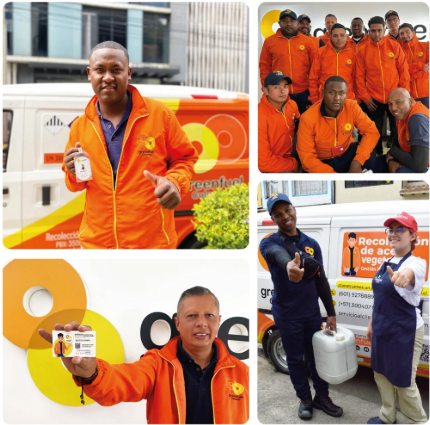
The company serves over 12,000 clients and employs more than 40 direct collaborators, in addition to a network of authorized collectors. Its core differentiators are the traceability certification under the European ISCC seal (in effect since 2013), an in-house logistics platform with routing applications, and a model that, instead of charging to take away the waste, pays the generator for their used oil.
Esteban Benavides, CEO, summarizes the origin and essence of the business: "This company was born for the collection of used vegetable oil... we were—we are—the first company to make an export of used vegetable oil".
=======================================
GreenFuel es la marca comercial operada por C.I. Transatlantic Greentrade S.A.S., empresa colombiana constituida en 2013. Opera en el sector de los biocombustibles y fue la primera empresa del país en exportar aceite vegetal usado (AVU). Tiene su planta de tratamiento en Soacha (Cundinamarca), coordina la recolección desde Bogotá y exporta a mercados como España, Países Bajos y Estados Unidos.
La compañía atiende a más de 12.000 clientes y emplea a más de 40 colaboradores directos, además de una red de recolectores autorizados. Sus diferenciadores centrales son la certificación de trazabilidad bajo el sello europeo ISCC (vigente desde 2013), una plataforma logística propia con aplicación de ruteo, y un modelo que, en lugar de cobrar por llevarse el residuo, le paga al generador por su aceite usado.
Esteban Benavides, su CEO, resume el origen y la esencia del negocio: “esta empresa nace para la recolección de aceite vegetal usado… fuimos —somos— la primera empresa en hacer una exportación de aceite vegetal usado”.