

Emma Prejean

Cooper Cook

Ethan Folse
Owen Schexnaydre

Nicholls State University

Christopher Castille

Keep this story going! Share below!
The company’s primary focus is coastal restoration, a critical issue in Louisiana due to ongoing land loss and environmental challenges. One of PPLLC’s most significant projects was the restoration of Queen Bess Island, located off the coast of Grand Isle, Louisiana. This island, once reduced to approximately five acres due to erosion and environmental damage, serves as one of the largest nesting grounds for Louisiana’s state bird, the brown pelican. The Queen Bess Island restoration project directly aligns with the United Nations Sustainable Development Goal 15: Life on Land, which emphasizes protecting, restoring, and promoting sustainable use of terrestrial ecosystems while halting biodiversity loss. The initiative aimed to rebuild the island’s habitat to support the brown pelican population and other coastal bird species.
The need for this project was largely driven by the devastating effects of the 2010 BP oil spill, which severely impacted the island’s ecosystem. As a critical nesting site hosting approximately 15–20% of Louisiana’s brown pelican population, the degradation of Queen Bess Island posed a significant threat to the species.
In response, PPLLC undertook a comprehensive restoration effort, ultimately expanding the island to approximately 37–38 acres and reestablishing it as a thriving bird and fish sanctuary. The restoration process involved reinforcing the island’s perimeter with rock breakwaters to reduce wave erosion and importing large quantities of sand to elevate and stabilize the land.
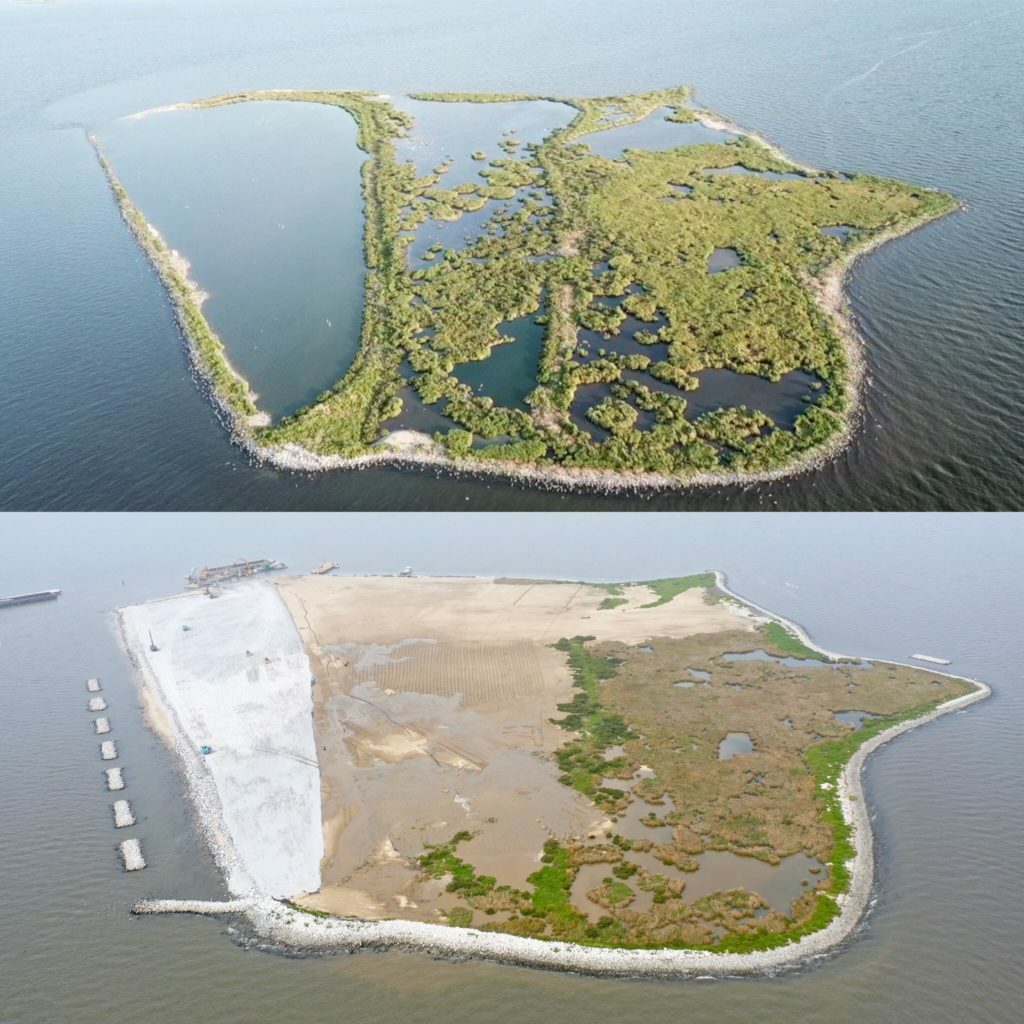
For Bart Cook, the project held deep personal significance. Having spent much of his life around Grand Isle and Louisiana’s coastline, he developed a strong connection to the region and its environmental health. He recalled seeing the island once filled with wildlife, only to witness its decline after the oil spill. This experience motivated his commitment to restoring the habitat.
Cook emphasized that the project, originally designed by biologists and commissioned by the Coastal Protection and Restoration Authority (CPRA), successfully fulfilled its goal of creating a sustainable habitat for the state bird. He described the outcome as deeply rewarding, noting that the project's true value extended beyond financial compensation to the preservation of Louisiana’s natural heritage.
The results of the restoration have been substantial. Following completion, the brown pelican population on the island increased by approximately 60%, with record numbers returning to nest. By 2023, Queen Bess Island supported nearly 30,000 birds and approximately 6,000 brown pelican nests—double the numbers recorded in 2010.
The island is now designed to remain viable for 25 to 50 years, providing a long-term solution to habitat loss. The Island is now a state park and a landmark for Louisiana. Residents and tourists are now able to watch the bird species thrive on the Island for many years to come.
In addition to ecological benefits, the project contributed to economic growth by creating approximately 20 jobs and supporting PPLLC's expansion. The company has grown from fewer than six employees to over 40 full-time staff members, along with a substantial field operations team. Today, PPLLC operates from its headquarters in New Orleans, with multiple branch offices across the Gulf South and the Midwest, allowing it to serve a broad client base. The company distinguishes itself by employing individuals with prior experience working for its clients, enabling a deeper understanding of client needs and expectations.
Over 267 days, PPLLC successfully transformed the island into a resilient habitat, earning $10.8 million upon completion. The project was funded in part through the broader $20 billion settlement from the BP oil spill, with approximately $18.7 million allocated to this restoration effort.
Environmentally, the project incorporated innovative engineering techniques, including the use of approximately 150,000 cubic yards of dredged Mississippi River sand to increase elevation and the installation of rock dikes to mitigate wave energy. Additional features, such as “bird ramps,” were installed to help juvenile birds safely navigate from nests to the water.
These efforts have created a robust, sustainable habitat that supports not only brown pelicans but also other species, such as Royal Terns and Sandwich Terns. Also, the project serves as a model for restoring coastal land and strengthening natural defenses against coastal land loss and future storms. It ultimately helped to keep the state bird from migrating out of the state.
Get stories of positive business innovations from around the world delivered right to your inbox.
Bart Cook, Founder

Pontchartrain Partners, LLC (PPLLC), based in New Orleans, Louisiana, was founded by Bart Cook and his partners with a shared vision of building a company rooted in their construction industry expertise. Like many small businesses, it began with a small group of professionals and has since grown into a diverse organization of highly specialized experts working across multiple facets of construction and coastal restoration.