

Becca Liaw
Miles Divis
Vir Kohli
Robbie Nicholson
Alexa Marie Ong
Jeannelle Tellado
Case Western Reserve University - Weatherhead School of Management

Megan Buchter


Keep this story going! Share below!
Rebuilders Xchange (RBX) aims to establish a circular economy for construction materials and household items by transforming and repurposing people’s material waste for sale. By preventing construction waste from entering landfills and extending the life cycle of materials, RBX’s business model aligns with the UN Sustainable Development Goals #11 (Sustainable Cities and Communities) and #12 (Responsible Consumption and Production). Through its consignment model, RBX promotes sustainable communities by leveraging its materials and enabling sellers to earn a profit rather than sending materials to landfills.
Rebuilders Xchange runs similarly to a consignment marketplace. Founded in 2012, this Cleveland-based company provides individuals, contractors, and businesses with a way to turn their surplus or scrap materials into a profit. Sellers pay an initial consignment fee, and if their item sells within a year, they receive fifty percent of the profit. If their item does not sell, then the seller has two weeks to pick it up. Otherwise, Rebuilders Xchange keeps the item and ensures it is repurposed, donated, or reused. Through this model, material is kept out of landfills and provides incentives for community members to contribute to the circular economy.
The RBX warehouse is a community-focused and larger-scale hub. Many of their inventory items include refurbished furniture or parts such as doors, windows, hardware, rugs, lighting, chairs, and other vintage elements. Jes Davis, the CEO, referred to the company store as similar to Home Depot. Open from 9 am to 4 pm, people can walk around and browse the ever-changing inventory, including niche items such as crystals or pottery. In addition to its physical storefront, the company’s online presence, with its website and online marketplace, including national shipping, gives local salvaged materials a wider customer base. More recently, Davis has integrated AI tools to help scale the business. Adopting a predictive-pricing model based on aggregated historical sales data and market trends, RBX streamlines item pricing to be more efficient while reducing waste and workflow in a traditionally manual-labor industry.
Through these efforts, RBX aligns with the UN Sustainable Development Goals #11 (Sustainable Cities and Communities) and #12 (Responsible Consumption and Production) through its circular economy model. By repurposing old parts and keeping them out of landfills, RBX works to increase sustainability and reduce waste while creating community wealth.
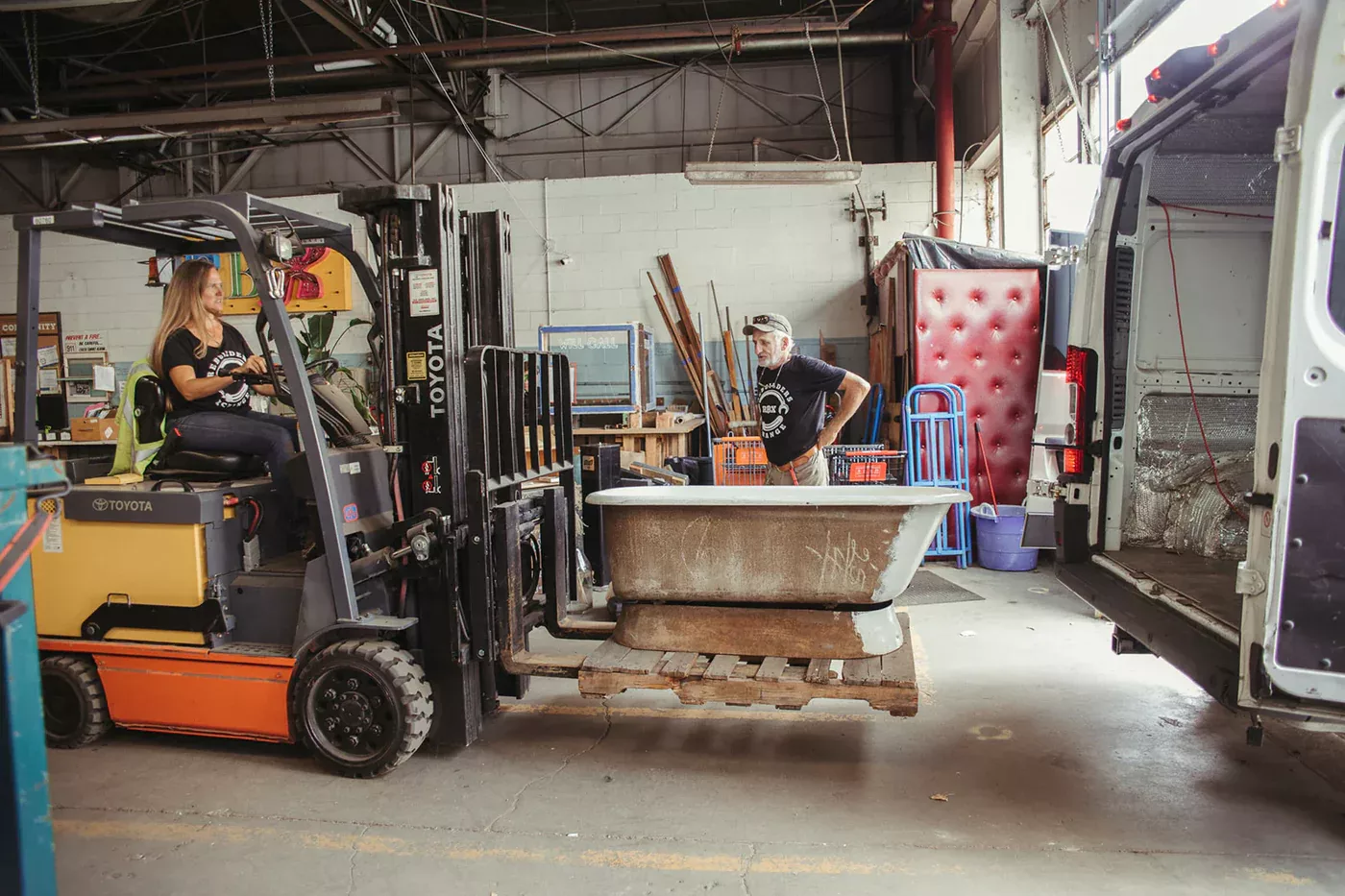
With her grandparents’ basement door handle repurposed from a thread spool, Davis has always been surrounded by repurposing and resourcefulness. Growing up in a rural farming community reinforced her family’s influence, teaching her to see value in overlooked materials. These sustainability and community-based passions led her to opportunities with AmeriCorps’s Habitat for Humanity program, Tremont Electric, a renewable energy startup, and a Shark Tank appearance. Her background in nonprofits and early work in repurposing materials birthed the idea for Rebuilders Xchange. As Davis explains, RBX acts as “logistical matchmakers,” connecting buyers and sellers to reinforce a circular economy. The company’s ethos was inspired by Davis’s desire to make RBX “profitable for people,” turning material waste into community wealth through its consignment model. Davis emphasized that RBX capitalizes on “access to material to make wealth for themselves,” creating a pathway for individuals to be part of sustainable practices while earning income.
Today, Davis’s inspiration is working with people who are passionate about building something meaningful, which fuels her entrepreneurial journey. She shared how meeting people from a place of contribution or partnership with individuals who share a mission for sustainability helped shape her vision for Rebuilders XChange. These relationships helped her believe that RBX can empower communities, create economic opportunities, and reduce waste.
This innovation created a meaningful impact for the local community and the environment of Cleveland, Ohio. Its core innovation is applying the circular economy model to construction materials, which historically does not have a sustainable material life cycle. RBX completes this process by salvaging reusable materials such as wood, doors, cabinets, light fixtures, metals, various outdoor fixtures and other items varying across an incredibly wide range of types of inputs that leads to an extensive inventory of output options. As a marketplace of repurposed items, RBX directly benefits a diverse group of people including homeowners, contractors, artists, small businesses, and any other builder of a DIY project, as they gain access to high-quality reclaimed materials at significantly lower prices than purchasing these materials brand new from large businesses and corporations. In the short-term, this innovation leads to reduced waste in Cleveland landfills and provides immediate economic advantages to both consignors and buyers as money is saved on both sides of the coin. By creating this marketplace for recycled goods, RBX also encourages more environmentally friendly purchasing in this industry.
Over the long term, through this circular-economy model, RBX leverages reuse and resource conservation to strengthen community sustainability. This impact can be seen in the thousands of pounds of wood, doors, cabinets, fixtures, and other materials that are diverted from landfills each year through RBX’s operations. Beyond the environmental impact of these reclaimed materials’ repurposed lives, RBX’s economic development promotes positive social change. Along with the local economic development, job creation, and supporting numerous renovation and restoration projects occurring in the city of Cleveland, this leads to long-term economic benefits. By offering affordable building materials and enabling sellers to monetize salvaged goods, RBX’s impact extends past environmental benefits to community-based economies.
The innovation benefits Rebuilders Xchange because it—and the business model—enable the business to avoid paying for the products received while still making a profit from the products sold. Even with the annual fee applied to consigners, that could be more than offset by the potential to profit from the sold consigned items, which allows Rebuilders Xchange to obtain items without necessarily paying for each one. This, on top of having consumers pay delivery fees, would allow the business to grow in revenue. On top of that, such revenue and donated/consigned products can enable the business to operate a FAB LAB, which involves crafting both new add-ons and new products from scratch; the business model—since it emphasizes reusing and recycling items—enables the business to fulfill the objectives of the FAB LAB, while not having to spend money on certain materials.
In addition, even if a consigned item remains unsold after a year and is not picked up by the consignor two weeks after that, Rebuilders Xchange would still find ways to make that unsold product useful, including giving it a new purpose. This could therefore create opportunities for the business to fulfill another responsibility, potentially leading to employee fulfillment. In addition, if the unsold item is to be reused in some way—and if others outside the business should be made known of it—the business could indirectly promote itself to potential customers.
Rebuilders Xchange benefits society primarily by reducing landfill waste through its circular-economy model, which recycles construction materials, hardware, and other fixtures. There are various types of items that RBX reuses. Materials such as wood, doors, windows, cabinets, and other fixtures from homes and commercial buildings that are being renovated or demolished, rather than sent to landfills, are sent to Rebuilders Xchange, which restores and resells them at affordable prices. This reduces the need for natural resources and reduces other pollution and harmful effects associated with producing these products brand-new. With the circular economy model, waste is diverted from landfills, limiting environmental harm, reducing the demand for and disposal of materials, and minimizing the time, energy, and emissions associated with manufacturing and transporting newly produced materials.
This organization strengthens the Cleveland community by producing high-quality materials at affordable prices. Thus, any local contractor, builder, homeowner, or anyone else in need of materials such as these has an environmentally friendly outlet to source them. This increases accessibility to sustainable efforts and practices, supporting people’s endeavors for home improvement, building preservation, or creative projects. Moreover, Davis centers RBX around the people. Through workshops, partnerships, and outreach programs, RBX also educates and engages community members about sustainability and responsible building practices. As an asset to the Cleveland community, RBX’s innovative system reduces waste, repurposes materials, supports affordability, and inspires the next generation of sustainability.
Get stories of positive business innovations from around the world delivered right to your inbox.
Jes Davis, CEO

Rebuilders XChange (RBX) is a hub of opportunities for environment, economic, and social growth in home building and design industries. This social enterprise's environmental impact through sustainability drives local economic opportunities. By promoting a circular economy, RBX connects sellers and buyers to repurpose material waste to create community wealth.