
Bhargavi .
Pranav P
Sneha K
Ishika Choudhary
SIDDHARTH SEN

Goa Institute of Management

Divya Singhal


Keep this story going! Share below!
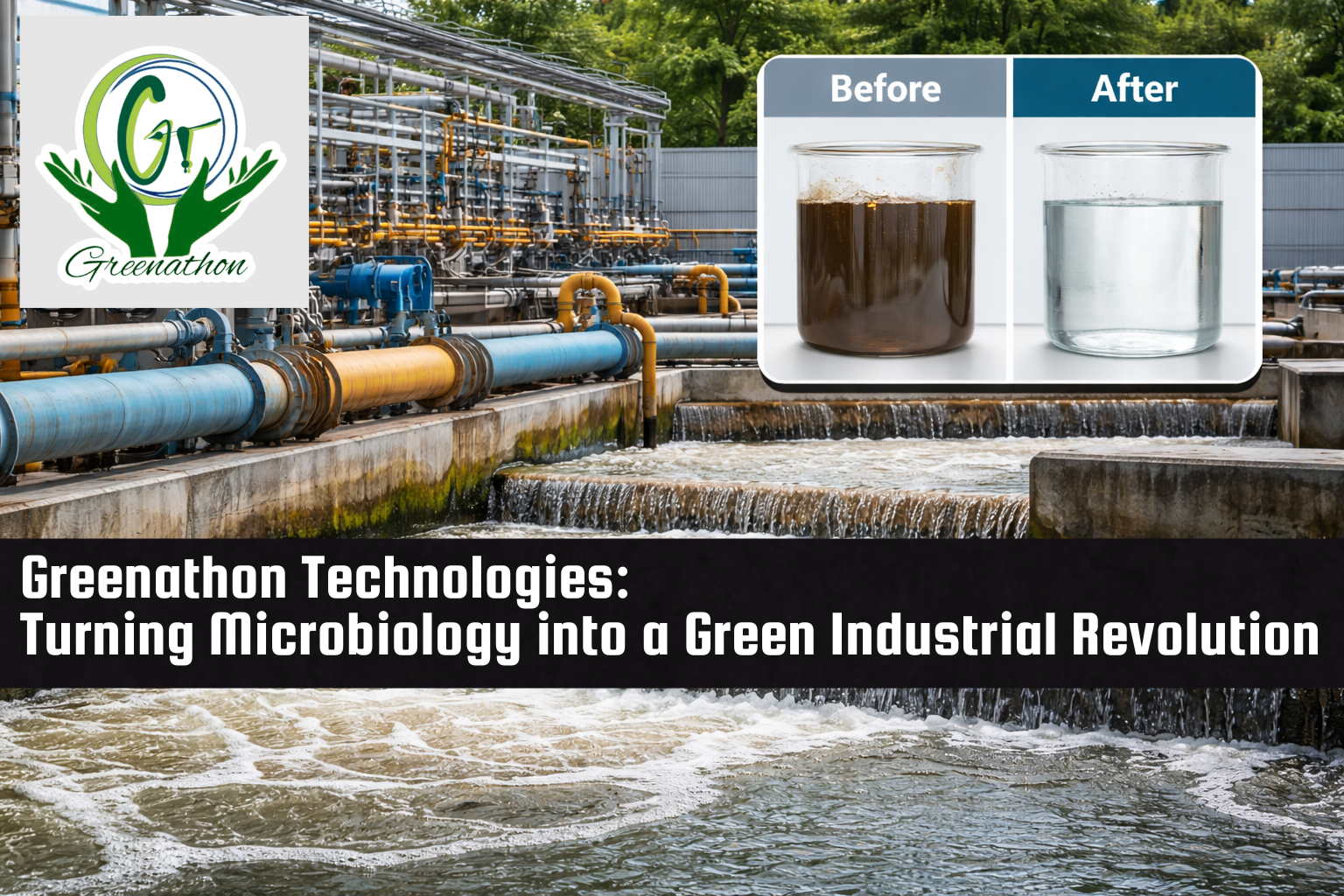
Greenathon Technologies has developed patented, microbe-assisted solutions for textile effluent treatment and paper recycling that replace harmful chemical processes with sustainable biotechnology. Its innovation enables industries to reduce water pollution, reuse up to 80% of treated water, lower electricity consumption, and meet environmental compliance standards, contributing directly to SDGs 6, 9, 12, and 13.
Greenathon Technologies’ core innovation lies in translating advanced microbiological research into scalable industrial solutions. The company developed two patented products: Microbiozyme for textile effluent treatment and Bio-De-Ink Solve for paper recycling. Unlike conventional chemical treatments that are toxic, energy-intensive, and compliance-heavy, Greenathon’s microbe-assisted technology uses naturally occurring bacteria and enzymes to biodegrade, decolourize, and detoxify industrial wastewater.
The innovation addresses a major environmental challenge in India’s textile and paper industries, where untreated or chemically treated effluents contaminate water bodies and increase soil toxicity. Through more than 350 industrial trials across Rajasthan, the company demonstrated that its solution can reduce operational expenditure by 40–45%, decrease electricity usage by nearly 70%, and enable industries to reuse up to 80% of treated water within their own systems. Additionally, the sludge generated is repurposed in other industries, supporting circular economy practices and zero-waste goals.
By combining cost competitiveness with environmental sustainability, Greenathon bridges the gap between low-cost hazardous chemical treatments and expensive high-end enzyme solutions. The innovation supports compliance with environmental regulations while lowering carbon footprints and improving ESG performance for businesses. Through its scalable, patent-backed green technology, Greenathon contributes to building a future-forward industrial ecosystem aligned with the UN Sustainable Development Goals and long-term environmental resilience.
Dr. Sarika Gupta’s inspiration to build Greenathon Technologies emerged from years of academic research combined with a deep concern for environmental degradation. Having completed her PhD in microbiology and spent years in research, she wanted her laboratory work to “see the light of the industry.” She shared that growing up, she continuously observed polluted water bodies near textile clusters and wondered why the problem persisted despite technological advancement.
She explained, “We thought there must be something which is cost-competitive and environmentally friendly that can solve both situations.” Her scientific background led her to explore how microbes and enzymes could be used to replace harsh chemical treatments in industrial effluents. The turning point came when she decided to translate research into real-world application under the Startup India initiative.
Dr. Gupta emphasised resilience as a key driver of her journey. “You should never give up… there is nothing which cannot be done. You just have to work 24/7,” she said, reflecting on the multiple grant rejections and early challenges she faced. She also highlighted the importance of purpose-driven innovation: “Problem identification serving the society should be the primary focus. Rest will follow.”
Ultimately, her motivation stems from a long-term vision: “We want to make our Mother Earth ready for our future generations.” This combination of scientific rigor, social responsibility, and entrepreneurial courage continues to shape Greenathon’s mission.
Greenathon Technologies’ innovation primarily impacts textile and paper manufacturing industries in Rajasthan, with expansion plans across India and internationally. Since its formal incorporation in 2020, the company has conducted more than 350 industrial trials across 280 industries in Rajasthan, demonstrating measurable environmental and economic benefits. The innovation works by introducing microbe-assisted enzyme formulations into existing effluent treatment systems, enabling biodegradation and detoxification of industrial wastewater without reliance on harsh chemicals.
In the short term, industries adopting Microbiozyme have reported operational expenditure reductions of approximately 40–45%, along with nearly 70% reduction in electricity consumption due to the static treatment model. Additionally, up to 80% of treated water can be reused within the same industrial facility, directly lowering freshwater dependency. These outcomes provide immediate financial savings and improved compliance with environmental regulations, including zero-discharge norms set by authorities.
In the long term, the innovation contributes to reduced carbon footprint, improved ESG performance, and advancement of circular economy practices. Sludge generated during treatment is repurposed for use in electroplating industries, reducing waste and supporting zero-waste management goals. The impact is supported by third-party validations, patent grants (2023 and 2024), government funding recognition from MSME, DST, and BIRAC, and the establishment of a pilot-scale manufacturing unit in Jaipur. These measurable results and institutional recognitions provide strong evidence that the innovation has generated both environmental and economic impact at scale.
Because Greenathon Technologies invested approximately ₹2.5 crore and over 2 lakh man-hours in research and development, it was able to convert academic microbiology research into two patented commercial products. As a result of this sustained effort, the company secured a process patent in 2023 and a product patent in 2024, strengthening its intellectual property portfolio and competitive positioning. The company also conducted more than 350 industrial trials across 280 industries in Rajasthan, validating its solution at a regional scale.
Because the business consistently applied for government support despite early rejections, it secured funding from MSME Government of India, DST NIDHI Prayas, and most recently the Biotechnology Ignition Grant from BIRAC. These grants enabled the company to conduct pilot deployments at its own cost and establish a pilot-scale manufacturing unit in Jaipur without diluting equity. This strengthened its operational capacity and supported early revenue-stage growth.
Because Greenathon optimised its cost structure by shifting from distributor procurement to direct sourcing, treatment costs reduced from approximately 20 paisa per litre to 10 to 12 paisa per litre. At the same time, the company maintained net margins of around 20 to 22 percent. This improved cost competitiveness allowed the firm to scale its B2B model within Rajasthan and prepare for expansion into other textile hubs across India. The development of its second product, Bio-De-Ink Solve, also expanded its reach into the paper and pulp industry, creating additional market opportunities aligned with its sustainability mission. They have also received many awards and media coverage.
Greenathon Technologies Private Limited was founded by Dr. Sarika Gupta, a microbiologist and academic researcher, with the vision of translating laboratory research into industrial solutions. The company began as a startup initiative following the Government of India’s Startup India Mission in 2016 and was formally incorporated as a private limited company in 2020. Based in Jaipur, Rajasthan, the company operates primarily in the textile and paper industrial sectors. Dr. Gupta, along with her research team at Banasthali Vidyapeeth and co-founder Dr. Ashish Kumar Dubey, leads the scientific development, business deployment, and supply chain operations.
The company developed two patented products, Microbiozyme for textile effluent treatment and Bio-De-Ink Solve for paper recycling. These solutions use microbe-assisted enzymatic technology to biodegrade, decolourize, and detoxify industrial wastewater and enable paper upcycling. The innovation was developed through extensive research and more than 2 lakh man-hours of scientific effort, supported by approximately ₹2.5 crore in R and D investment. The company conducted over 350 industrial trials across 280 industries in Rajasthan to validate the effectiveness of its technology.
Through a B2B deployment model, Greenathon works directly with industries to reduce operational costs, improve environmental compliance, and promote water reuse. The company has validated its model regionally and is preparing for expansion into other textile hubs across India, with long-term aspirations to enter global markets.
Get stories of positive business innovations from around the world delivered right to your inbox.

Greenathon Technologies Private Limited is a deep-tech biotechnology startup based in Jaipur, Rajasthan, that delivers sustainable, microbe-assisted industrial solutions. The company develops patented green technologies for textile effluent treatment and paper recycling to reduce chemical pollution and promote circular economy practices. By enabling industries to lower operational costs while meeting environmental compliance standards, Greenathon supports sustainable manufacturing aligned with global Sustainable Development Goals.