

Ushnish Chakraborty

Kunal Bhandari

Kalyani Binu

Shashwat Rawat
Sarthak Khaddar

Goa Institute of Management

Divya Singhal


Keep this story going! Share below!
This innovation is about engineering large-scale solar thermal and heat pump systems that significantly reduce electricity consumption and carbon emissions in high-demand buildings. By designing commercially viable, high-performance sustainable thermal solutions, the company advances SDG 7 (Affordable and Clean Energy) and SDG 13 (Climate Action) while supporting SDG 9 (Industry, Innovation and Infrastructure). The model proves that climate-conscious engineering can deliver both environmental impact and strong financial returns.
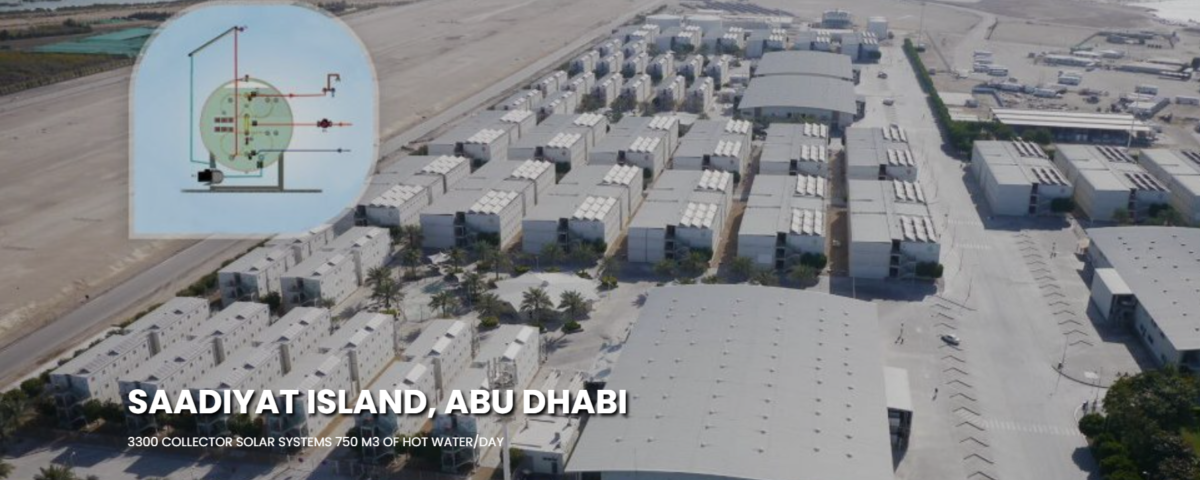
In 2009, with a team of just three people, the company engineered what was showcased as the world’s largest single-location solar hot water system: 3,300 solar collectors producing approximately 750,000 liters of hot water per day for a 20,000-person labor camp on an island in Abu Dhabi. Despite logistical challenges, including boat-only access and strict timelines, the team broke the project into manageable parts and delivered it in record time. The system dramatically reduced reliance on electric heating, lowered long-term energy costs, and significantly cut carbon emissions.
Building on this success, the company pioneered the use of water-source heat pumps in space-constrained high-rise hotels. In partnership with major hospitality groups, it retrofitted 600-room properties by using existing chiller water as a heat source to generate 60–70°C hot water, achieving 80–90% energy savings compared to conventional electric or boiler systems. The innovation lies not only in the technology but in combining precise payback calculations, engineering customization, and long-term sustainability thinking. By balancing commercial viability (“the head”) with environmental responsibility (“the heart”), the company demonstrated that profitable infrastructure can also serve future generations by reducing carbon emissions and enabling scalable clean energy adoption.

Championing Quality, Innovation, and Sustainable Impact
The inspiration behind this innovation began not with the word “sustainability,” but with the desire to differentiate and create long-term value. As Mr. Sebastian explained, “At that point, nobody did talk about sustainability. The common jargon used was how to save energy.” Initially selling pumps, he realized that “a pump is just a pump, it’s going to become a commodity very soon.” A consultant friend advised him to explore solar hot water systems, saying that in a few years, “everybody would be talking about this.” Though he had “no clue what this was” at the time, the idea made sense, and he decided to “join the bandwagon.”
As the journey progressed, his motivation deepened beyond business differentiation. He shared that once he understood the larger impact, it became about “what we’re doing for our future, the future of our children, for our planet Earth.” Despite discouragement from developers and government entities who questioned whether solar made sense in a hot country, he persisted. He emphasized that success required resilience: “Discouragement is always a part of success.”
A defining philosophy guiding his decisions was balancing commercial logic with moral conviction. He explained, “You need to use your head and you need to work through your heart, the head will tell you let’s work commercially. The heart tells you, let’s do the right thing.” Ultimately, the innovation was inspired by a belief that businesses must “deliver some value” while “contributing to lower carbon dioxide emissions” and doing something meaningful “for the future generation.”
The innovation transformed sustainable thermal systems from a niche solution into a commercially accepted and policy-supported standard. In the short term, large-scale implementation demonstrated that solar thermal and heat pump technologies could deliver measurable energy savings even in high-demand settings. Hospitality clients, such as international hotel groups, reported 80–90% reductions in energy consumption after retrofitting conventional electric and boiler systems with water-source heat pumps. These verified savings built market confidence and led to replication across multiple hotel properties in the region.
Over the long term, the impact extended to regulatory and market-level change. Municipal authorities in Dubai, Abu Dhabi, and Sharjah later mandated sustainable hot water systems for residential dwellings, resulting in thousands of villas integrating solar thermal systems as a standard requirement. The company also successfully advocated for heat pumps to be recognized as an approved alternative for vertical high-rise buildings with limited rooftop solar space. This policy adaptation expanded scalability across dense urban developments.
Evidence of sustained impact includes recognition as the number one global distributor for its technology partner in 2009–10, continued industry awards including Top 10 Asian CEOs in Sustainability (2024–25), repeat contracts from institutional clients, and growth from a three-person operation to a 25-person engineering-led organization. Collectively, these outcomes indicate measurable environmental benefits, regulatory influence, and long-term commercial viability.
The strategic shift from selling commoditized pumps to delivering engineered sustainable energy systems repositioned the company into higher-value, design-led projects with stronger margins. Following the successful execution of the large-scale 2009 installation, the company gained international recognition and was ranked the number one global distributor for its technology partner in 2009–10. This credibility enhanced its competitive standing and helped secure larger institutional contracts. Over time, the organization expanded from a three-person startup to a 25-person engineering-driven team, reflecting sustained revenue growth and operational scaling.
Demonstrated performance also translated into repeat business. In one 600-room hospitality retrofit, verified energy savings of 80–90% led the client to replicate the solution across seven properties in the region. Thousands of villa installations followed as municipalities mandated sustainable hot water systems, creating consistent demand and predictable project pipelines. These mandates significantly expanded the addressable market while reducing reliance on one-off projects.
Advocacy efforts to include heat pumps as an approved alternative for high-rise buildings further opened new commercial segments. This policy shift enabled entry into vertical developments and space-constrained projects that rooftop solar alone could not serve. Collectively, the innovation strengthened long-term revenue stability, expanded market access, enhanced brand equity, and positioned the company as a technical leader in sustainable thermal infrastructure.
This innovation directly advances UN Sustainable Development Goal 7 (Affordable and Clean Energy) by increasing access to renewable and energy-efficient hot water systems across residential, commercial, and hospitality sectors. Beginning with large-scale solar thermal installations in 2009 and expanding to thousands of villas through municipal mandates in Dubai, Abu Dhabi, and Sharjah, the company helped shift hot water generation from conventional electric systems to solar and high-efficiency heat pumps. In one installation serving 20,000 people, approximately 750,000 liters of hot water per day were generated using solar energy, significantly reducing electricity demand.
The innovation also supports SDG 13 (Climate Action) by lowering long-term carbon dioxide emissions through 80–90% energy savings in hospitality retrofits and sustained reductions in residential electricity use. With system lifespans of 20–25 years, cumulative emissions reductions extend far beyond the initial installation period. By advocating for regulatory inclusion of heat pumps in vertical buildings, the company enabled scalable adoption in high-rise developments, reinforcing SDG 9 (Industry, Innovation, and Infrastructure) through engineering-led infrastructure transformation.
Socially, the innovation contributes to reliable essential services, aligning with SDG 11 (Sustainable Cities and Communities) by embedding clean energy infrastructure into urban development. Thousands of households and hotel occupants now benefit from lower lifecycle energy costs and reduced environmental impact. As articulated by the leader, the effort was about “doing something for the future generation” and about lowering carbon emissions, demonstrating how commercially viable engineering solutions can generate measurable environmental and societal value.
Get stories of positive business innovations from around the world delivered right to your inbox.

EcoVal Trading LLC is a sustainable energy solutions company specializing in heating, cooling, and energy conservation systems. Its core offerings include solar thermal systems, heat pumps, boilers, chillers, air conditioning systems, and energy metering solutions for residential, commercial, and industrial applications. With offices across the Middle East, the company focuses on delivering high-performance, environmentally responsible systems that meet or exceed customer expectations. Guided by transparency, strong technical expertise, and a solution-oriented approach, it aims to provide sustainable energy and environmental solutions while maintaining long-term financial strength and operational excellence.