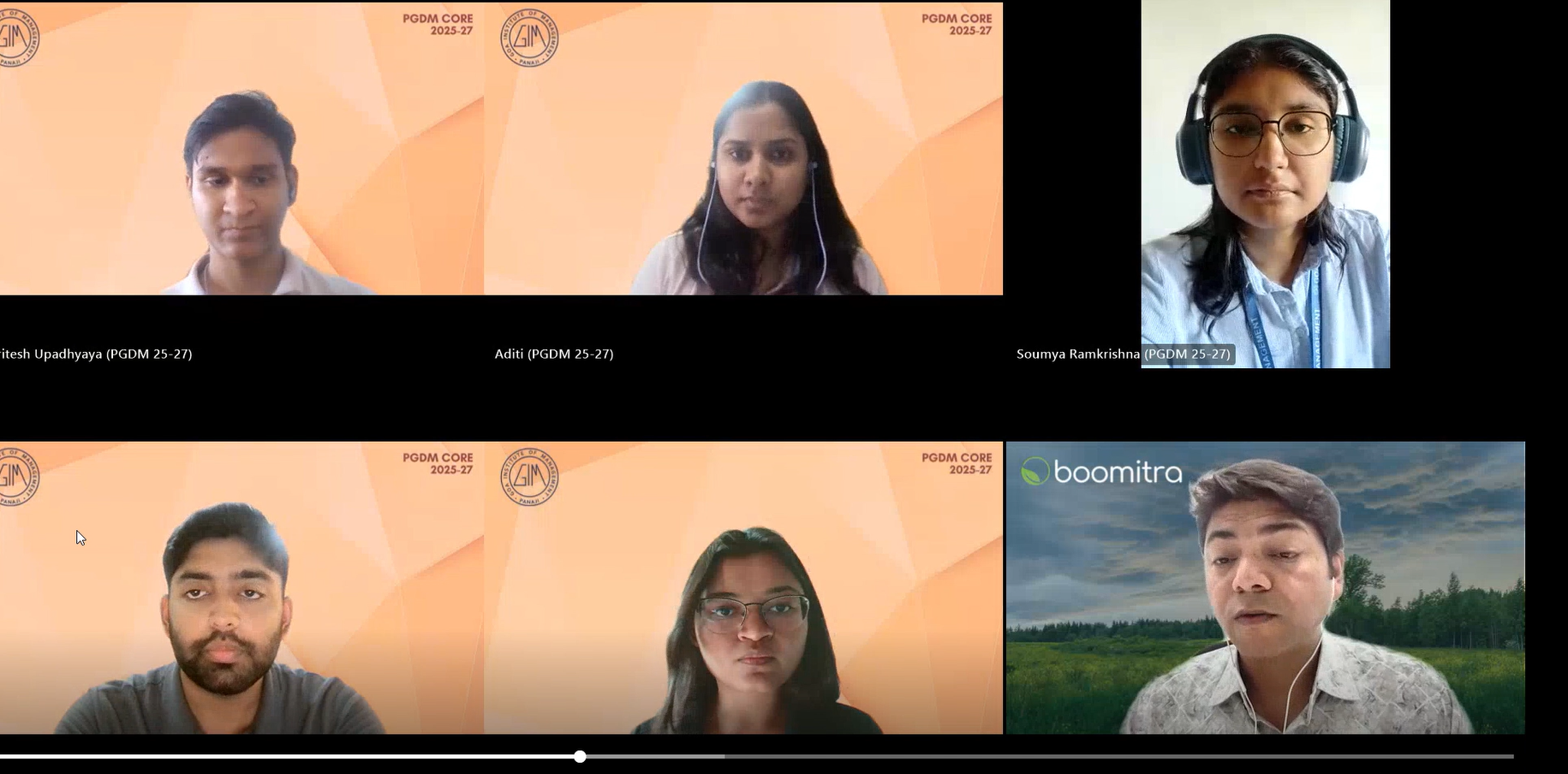

Ananya Pandey
Amritesh Upadhyaya
Soumya Ramkrishna
Aryan K
Aditi NA

Goa Institute of Management

Divya Singhal


Keep this story going! Share below!
Boomitra develops large-scale, AI-powered soil carbon removal projects that help farmers and ranchers adopt regenerative agriculture while generating high-integrity, third-party-verified carbon credits. Using satellite imagery, machine learning, and robust scientific modeling, Boomitra measures soil carbon improvements and connects producers, especially smallholders to global carbon markets. The model restores degraded land, strengthens climate resilience, and enhances rural prosperity, directly advancing SDGs including No Poverty, Zero Hunger, Gender Equality, Decent Work & Economic Growth, Climate Action, and Life on Land. Through its “soil-to-school” approach, Boomitra channels most revenue back to farmers and communities, ensuring regeneration delivers measurable social impact.
Boomitra is a global climate-tech leader pioneering AI-driven soil carbon sequestration across croplands and grasslands. Operating across four continents, including regions in India, Kenya, Mexico, Argentina, and the United States; the organization works with over 100 implementation partners, cooperatives, NGOs, and field organizations. Its mission is rooted in a single transformative idea: use advanced AI and satellite science to bring the world’s farmers into the climate economy.
The company’s breakthrough innovation lies in revolutionizing how soil carbon is measured, monitored, reported, and verified. Historically, soil carbon projects required extensive physical sampling, slow, costly, and inaccessible for smallholder farmers. Boomitra developed the first Verra-approved remote sensing methodology for soil organic carbon, combining over one million laboratory soil samples with multispectral and radar satellite data. Using machine learning, Geospatial Bayesian Uncertainty Analysis, and RothC modelling, Boomitra accurately measures carbon up to 30 cm depth under methodologies such as VM0042 and SCM0005.
This innovation reduces soil sampling costs by 80–90% and enables project development across millions of acres at unprecedented scale. Today, Boomitra’s projects benefit over 150,000 farmers, span more than 5 million acres, and have resulted in approximately 10 million tonnes of CO₂ removed from the atmosphere. By lowering the cost of trust and democratizing climate finance, Boomitra empowers smallholder farmers traditionally underrepresented in carbon markets to earn reliable, additional income. The innovation directly regenerates ecosystems, increases yields, improves soil health, and strengthens rural livelihoods, all while producing high-integrity carbon removal credits.
The genesis of Boomitra is not merely technological, it is profoundly human. Founder Aadith Moorthy’s inspiration began during a visit to rural South India, where he encountered the funeral procession of a farmer who had taken his life following crop failure caused by erratic rainfall. The moment revealed how environmental instability directly translates into economic and emotional distress for farming communities.
During our interview, Director – Projects APAC, Abhinav Gupta, reflected: “A farmer had to take his life because his crop failed… it put pressure on what we can do to support the farming community globally.” The incident reframed climate change from an abstract environmental issue into a livelihood crisis affecting millions of smallholders. Instead of viewing farmers as contributors to emissions, the founding team began asking whether they could become central participants in the climate solution.
The question soon emerged: Could technology protect farmers from climate volatility while restoring the planet? With Moorthy’s background in AI and materials science, the team explored whether advanced remote sensing and geospatial modelling could turn soil restoration into a reliable income stream. Mr.Gupta emphasized the central design principle from the early years: “Remote sensing helps us work at scale and reduce soil sampling cost by 80–90%. That is what makes soil carbon projects accessible to small farmers.” The innovation arose from merging empathy with engineering, reimagining farmers not as victims of climate change, nor as contributors to emissions, but as essential partners in climate action. Boomitra’s model is built on a simple but radical premise: regenerating soil should regenerate lives. From this philosophy emerged a globally scalable, farmer-centric climate solution.
Boomitra’s innovation delivers impact at multiple levels—farm, community, ecosystem, and global carbon systems. As Abhinav Gupta shared: “We are present across continents… working with ranchers in grassland regions and smallholder farmers in croplands. Our projects differ by ecosystem, but our goal is the same: soil restoration and farmer prosperity.”
Across Latin American grasslands, African smallholder regions, and Indian croplands, Boomitra has scaled regenerative practices across 5+ million acres, benefitting 150,000+ farmers and enabling the removal of ~10 million tonnes CO₂. The company’s work with partners like Terra Carbono, SOVIN, URVARA, and dozens of grassroots organizations ensures hyper-local relevance and high community participation.
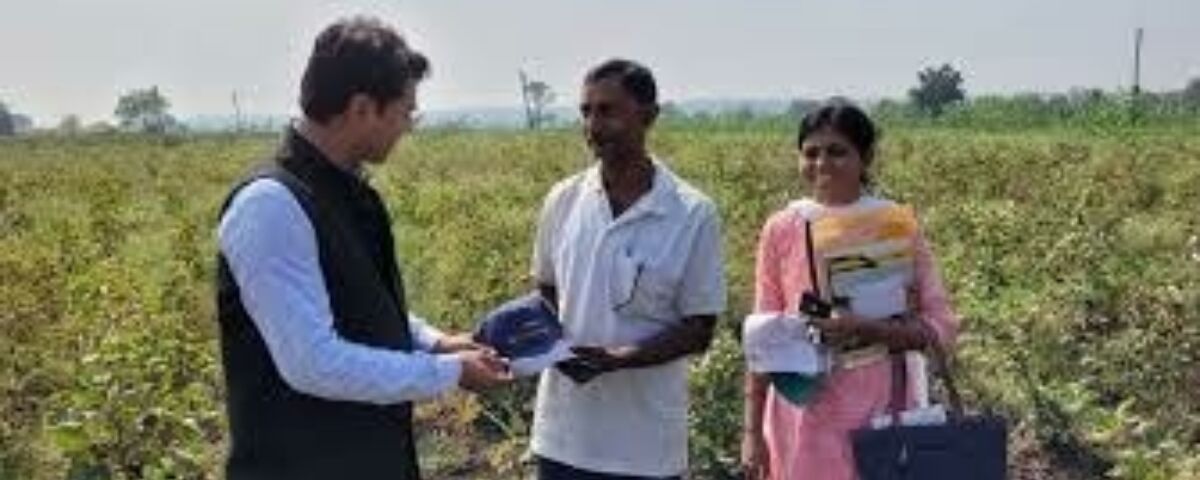
At the farmer level, impacts are measurable and immediate. In the URVARA project in India, Ravi, a participating farmer transitioned from chemical inputs to regenerative practices such as mulching, organic manure, minimal tillage, and cover cropping. His soil structure improved, earthworms returned, and his yields rose by 8–10% annually. He saved nearly ₹15,000 per year by reducing chemical inputs and stored 2.38 tonnes of CO₂e in his soil between 2021 and 2024.
Over the long term, the transformation is systemic. Restored soils retain more water, improve biodiversity, and withstand extreme climate shocks. Communities gain enhanced food security and diversified incomes from carbon finance. Mr.Gupta summarized this systemic impact: “If soil organic carbon is increasing… carbon dioxide is getting removed from the environment.”
Boomitra’s innovation thus converts agriculture from an extractive system into a regenerative engine for climate action and rural resilience.
Because Boomitra pioneered a Verra-approved AI-driven remote sensing system for soil carbon measurement, it drastically reduced the cost, time, and complexity of producing high-quality carbon credits. This technology enabled the company to scale across four continents, working with over 100 partners, and significantly expanded its credit issuance and market reach. As Abhinav Gupta explained: “Remote sensing helps us work at scale and reduce soil sampling cost by 80– 90%.” Because the innovation strengthened scientific rigor, Boomitra earned trust and recognition from prestigious institutions. The organization is backed by collaborations with the World Economic Forum, the World Food Programme, Government of Singapore, DP World, British Airways, Mitsubishi Coporation, Deloitte, and others. In 2023, Boomitra won The Earthshot Prize, selected from over 1,100 global nominations. Boomitra also received the TIME 100 Most Influential Companies – 2024 award.
Because the company demonstrated large-scale integrity and measurable climate impact, it secured major commercial and sovereign transactions such as the issuance of 3.03 million soil carbon credits from the Northern Mexico grassland project and an agreement for 625,000 tonnes of carbon credit purchases with the Government of Singapore.
Growth has enabled Boomitra to expand teams across scientific R&D, geospatial engineering, AI, field implementation, and community operations. The business model where 75% of revenue flows to farmers and local partners has strengthened reputation, partner retention, and long-term project stability. By aligning impact with profitability, Boomitra has positioned itself as a global leader in next-generation, high-integrity carbon removal markets.
Boomitra’s innovation delivers profound environmental and social benefits by enabling regenerative land management at scale. Across India, Kenya, Mexico, Argentina, Brazil, and Southern Africa, the organization helps farmers and ranchers adopt practices such as mulching, organic inputs, agroforestry, rotational grazing, water-efficient farming, and reduced tillage. These practices increase soil organic carbon, strengthen biodiversity, reduce erosion, and enhance water retention. Mr. Gupta summarized the climate impact succinctly: “If soil organic carbon is increasing…carbon dioxide is getting removed from the environment.”
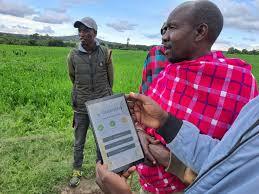
Through remote sensing and AI, Boomitra ensures these changes are measured accurately and cost-effectively, opening carbon markets to smallholder farmers who were previously excluded. Verified Carbon Units (VCUs) provide farmers with a stable second income, reducing vulnerability to climate shocks and market fluctuations. This is especially transformative in India’s URVARA and SOVIN projects, where over 70,000 farmers and 250,000+ acres are engaged with 70% of revenue flowing directly to farmers, and 20% to local implementation partners, ensuring community value capture. In Kenya, partnerships with local organizations have helped farmers adopt regenerative cropping systems across cereals, pulses, fibers, and other crops improving resilience while generating measurable carbon removals.
Beyond climate mitigation, Boomitra’s work advances multiple SDGs: poverty reduction (SDG 1), food security (SDG 2), gender inclusion (SDG 5), decent work (SDG 8), climate action (SDG 13), and ecosystem restoration (SDG 15). The “soil-to-school” model further ensures social benefits reach communities through employment, training, education, and improved rural infrastructure. By making soil restoration economically rewarding, Boomitra delivers a regenerative model where environmental health and community well-being reinforce one another.
Get stories of positive business innovations from around the world delivered right to your inbox.

Boomitra develops large-scale, AI-powered soil carbon removal projects that help farmers and ranchers adopt regenerative agriculture while generating high-integrity, third-party-verified carbon credits. Using satellite imagery, machine learning, and robust scientific modeling, Boomitra measures soil carbon improvements and connects producers, especially smallholders to global carbon markets. Through its “soil-to-school” approach, Boomitra channels most revenue back to farmers and communities, ensuring regeneration delivers measurable social impact.