

Janneth Villagrana
David Babin

Nicholls State University

Christopher Castille


Keep this story going! Share below!
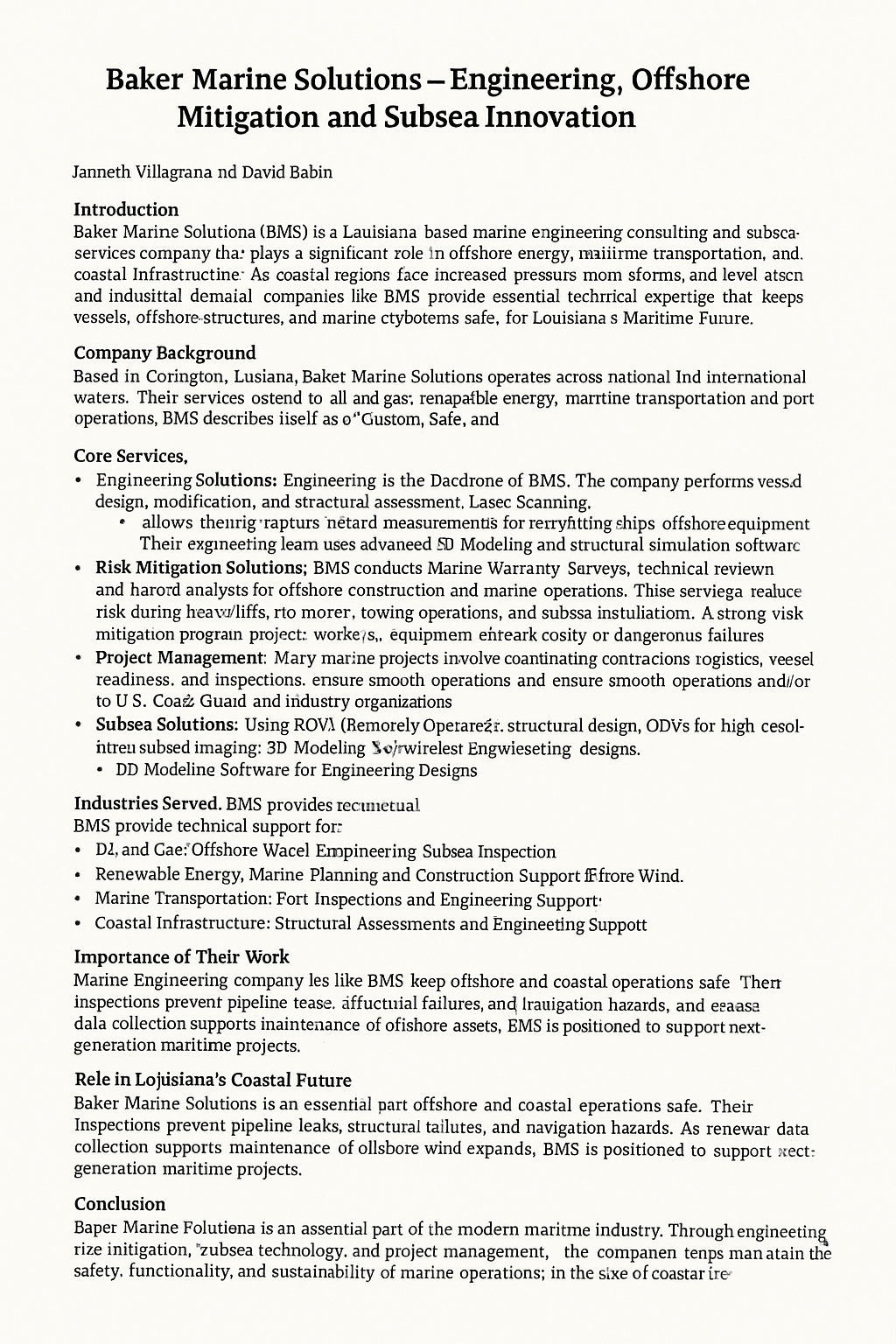
One of BMS’s key innovations is its integration of advanced subsea inspection technology and real-time 3D imaging, through its subsea division (often referred to as Baker Subsea Solutions, part of BMS). This solution gives clients detailed, timely, and accurate inspections of underwater assets, supporting safer, more efficient, and environmentally responsible marine operations. By enhancing asset integrity and mitigating risks in offshore operations, this innovation supports sustainable energy projects and promotes safer marine industry practices, aligning with the UN Sustainable Development Goals related to industry innovation, safety, and environmental protection.
The inspiration for BMS’s subsea inspection innovation grew out of the increasing complexity and risk of modern offshore operations, especially in oil & gas and emerging renewable-energy sectors, where underwater infrastructure (pipelines, cables, foundations, rigs) demands rigorous inspection and maintenance. Traditional inspection methods often involved costly downtime, limited visibility, or relied heavily on manual checks, which posed safety and efficiency challenges. Recognizing this gap, BMS sought a better way to provide reliable, accurate, and efficient underwater inspections.
To implement the solution, BMS expanded its capabilities around 2023–2024 through its subsea division. Equipped with inspection-class remotely operated vehicles (ROVs) and staffed with qualified pilots and technicians, the company began offering underwater inspections down to 600 meters. Using real-time 3D imagery and metrology, their clients’ asset-integrity teams can closely monitor structural health, detect corrosion or damage, and plan maintenance or repairs proactively.
Today, this innovation allows offshore operators to perform thorough inspections of subsea infrastructure without the delays or risks associated with human-diver inspections or infrequent manual surveys. The real-time 3D imaging and advanced data capture provide a major improvement over older methods, enabling predictive maintenance, reducing environmental risk (e.g., leaks, structural failure), and enhancing safety. In doing so, BMS supports more sustainable and responsible marine operations, a step toward better stewardship of ocean resources and infrastructure reliability.
The innovation reflects the leadership and vision of Jim Baker, Founder and President of BMS. Jim climbed the ranks from deckhand offshore to marine manager and ultimately founded the company, drawing on decades of firsthand experience at sea.
In an interview, Jim described the motivation as coming from “a deep-seated passion for the sea” and a desire to offer “solutions that ensure safety and integrity both above and below water.” Under his guidance, BMS expanded from traditional marine assurance services into subsea inspection and advanced engineering, reflecting his belief that the maritime industry must constantly evolve and adopt smarter, safer technologies.
According to Jim, “the future of offshore operations depends not just on what you build, but how well you maintain it, from deck to seabed.” That philosophy drove the creation of the subsea services division and underscores BMS’s commitment to long-term sustainability and risk mitigation in marine operations.
In the short term, BMS’s subsea inspection services have enabled clients to rapidly assess the integrity of underwater assets, schedule maintenance proactively, and avoid costly downtime or environmental incidents. Operators report improved confidence in their infrastructure, and in several cases, issues such as corrosion or potential structural vulnerabilities were detected early, before they escalated into major problems. This demonstrates a direct safety and cost-saving benefit.
In the long term, as more offshore projects, particularly in renewables and energy transition, rely on robust subsea infrastructure, BMS’s approach could significantly reduce the risk of failures, oil spills, or environmental damage. As these services scale globally (especially following BMS’s 2025 partnership with international firms through a signed MOU), the innovation may contribute to safer, cleaner marine operations worldwide.
Moreover, by providing unbiased, high-quality inspections and engineering assessments, BMS supports the long-term viability of offshore installations, helping marine operators meet both regulatory and environmental standards, which is crucial in an era that prioritizes sustainable energy development and environmental protection.
Since developing its subsea inspection services, BMS has expanded its service offerings beyond traditional marine assurance and vessel design. This diversification has opened new markets, including subsea infrastructure inspection for both oil & gas and renewable-energy clients. As a result, BMS has likely increased revenue streams and strengthened its competitive position. According to some data, the estimated annual revenue is approximately USD 23.9 million, and the company has grown its employee count by about 25% over the last year.
The expanded services have also deepened client relationships. Because BMS can now handle everything “from surface to seafloor,” clients see them as a one-stop partner, which improves retention and trust. Internally, adding subsea operations required hiring ROV technicians, inspectors, and support staff, creating jobs, enhancing employee expertise, and broadening BMS’s technical capacity.
Ultimately, the ability to offer advanced inspection technology positions BMS as a leader in the industry. This not only attracts new clients (including major energy companies and renewables operators), but it also opens opportunities for future projects and collaborations, especially as offshore renewables grow and safety/environmental standards become more stringent.
For society and the environment, BMS’s subsea inspection innovation helps ensure that offshore operations are safer, more reliable, and less prone to catastrophic failures, such as leaks, structural collapses, or environmental contamination. By detecting issues early, companies can maintain infrastructure and avoid harmful incidents that could damage marine ecosystems or threaten workers’ safety.
This contributes to sustainable development by supporting responsible use of ocean resources and encouraging maintenance over neglect, which aligns with SDGs promoting industry innovation, infrastructure resilience, and environmental protection. As more renewable-energy offshore projects come online (wind farms, underwater cables, platforms), BMS’s services help ensure these installations are built and maintained sustainably.
Additionally, by combining engineering excellence with global reach (through recent partnerships), BMS helps propagate best practices worldwide, raising the standard for marine safety and environmental stewardship beyond its own operations. In doing so, the innovation supports a more sustainable global marine industry that values both human safety and ecological preservation.
Get stories of positive business innovations from around the world delivered right to your inbox.
Cade Ball, ROV SR TECH/MARINE SURVEYOR
Baker Marine Solutions (BMS) is a Louisiana-based marine engineering consulting and subsea services company that plays a significant role in the offshore energy, maritime transportation, and coastal infrastructure sectors. As coastal regions face increased pressure from storms, sea-level rise, and industrial demand, companies like BMS provide essential technical expertise that keeps vessels, offshore structures, and marine ecosystems safe. Their work combines engineering, technology, risk reduction, and environmental awareness, making them a key contributor to Louisiana's maritime future.