

Ruslan Zabarov
Marina Kamperai
Artem Zabarov

Ben Collier

Case Western Reserve University - Weatherhead School of Management

Megan Buchter


Keep this story going! Share below!
The central innovation behind Zentra is deceptively simple: a water bottle cap embedded with breath-health sensors. Blow into the bottle after drinking and the device tells you the precise water quality, bundled with a supplement reminder system. An app, or LED lights on the bottle itself, shows your progress over time. It is health monitoring that requires no extra steps, no new habit, no separate device to carry.
What makes this more than a clever gadget is the closed feedback loop Li has built at the heart of the product. Users are not just collecting data - they are watching themselves improve in real time. That visible progress, Li argues, is what keeps people engaged where other health tools fail. The gamification of well-being, anchored to something as universal as drinking water, is the product’s real breakthrough.
Li studied existing markets carefully. Companies like LifeFuel had already introduced water bottles with dispensing systems, but found customers unwilling to sustain the ongoing cost of replacement pods. Li’s insight was that the failure was not about the product concept - it was about value structure. Zentra’s model is built around a one-time purchase with intrinsic, daily value, rather than a subscription that demands continuous buy-in.
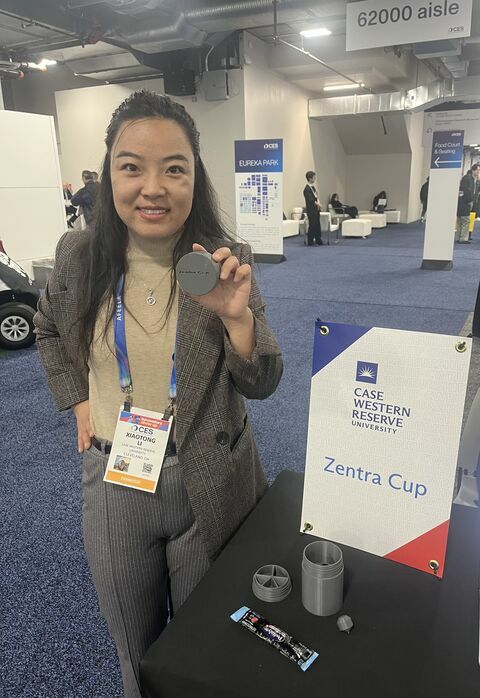
Xiaotong Li, founder of Zentra explained that the inspiration for the company came from combining philosophy and technology to improve everyday health habits. “ The name Zentra comes from the philosophy of Zen which reflects balance and mindfulness”, Li said. The company focuses on using technology to support healthcare and help people keep track of their oral well being. Li also explained that many people struggle with consistency in maintaining healthy routines. “ People carry their water bottles everywhere, but they often forget their pillbox or forget to check their breath health”, she said.
Xiaotong Li did not set out to build a health company. She set out to solve a behavioral problem she saw all around her: people who wanted to take care of their health but could not make the habits stick. Taking daily supplements, staying hydrated, knowing whether the water you drink is actually clean - these are simple acts, but they fall through the cracks of busy days.
Li's background in electronic devices and sensor engineering gave her a useful lens. She did not see a world that needed better medical devices. She saw a world full of everyday objects that could quietly become health tools, if only someone thought to put the sensors in the right places. The water bottle was obvious in retrospect: it is one of the few objects that travels with people throughout their day, morning to night, at home and at work.
"I want technology to be able to help human beings instead of human beings being controlled by technology."
The impact of the innovation on the business, a water bottle cap embedded with breath health sensors, allows the company to reach a broader market of consumers interested in convenient health monitoring. The innovation also has potential societal benefits because it addresses a common challenge related to maintaining healthy habits. As the founder explained, “Medical adherence and consistency is a big deal, and it is really hard for people to keep up with it.” By integrating breath monitoring and reminders into a product people already use daily, the technology makes health tracking more convenient, affordable, and accessible for everyday consumers. Although there is not yet a proven track record of Zentra’s impact because the company is still in its early stages, the technology and existing product concept have significant potential to improve how individuals track and manage their health.
Zentra's commercial model is grounded in alignment with human behavior. By embedding health monitoring into an object consumers already rely on, the product creates habitual daily engagement without requiring willpower or schedule changes. This makes long-term user retention structurally more likely than in products that ask users to build new routines from scratch.
The single-purchase B2C model avoids the subscription fatigue that undermined competitors in the smart water bottle category. Customers pay once and receive ongoing value - a proposition that is easier to communicate and easier to sustain. Li's plan to manufacture in China while keeping design and technology development in the US preserves product quality and IP control while keeping costs low enough to reach a broad consumer base.
Zentra’s greatest societal contribution is access. Health monitoring technologies have historically been expensive, clinical, and inconvenient. Zentra brings that capability into a $20-$40 consumer product that lives in a backpack or on a desk. That shift democratizes health awareness in a way that more sophisticated devices cannot.
For communities where healthcare access is limited and preventive care is least common, an affordable tool that flags early health signals and encourages medication adherence could have outsized impact.
Get stories of positive business innovations from around the world delivered right to your inbox.
Xiaotong Li, Founder
Zentra’s product is a smart water bottle designed to monitor breath health and provide real time feedback. With a background in polymer science, electronic devices and sensors, Li realized that she could integrate healthy monitoring to objects people use daily. By embedding sensors into a water bottle the bottle can track aspects of breath health and help users understand how their hydration and habits affect their overall oral health.