

Josie T.
Téa T.
Ethan S.
Carrie L.
Case Western Reserve University - Weatherhead School of Management

Chris Laszlo

Megan Buchter


Keep this story going! Share below!
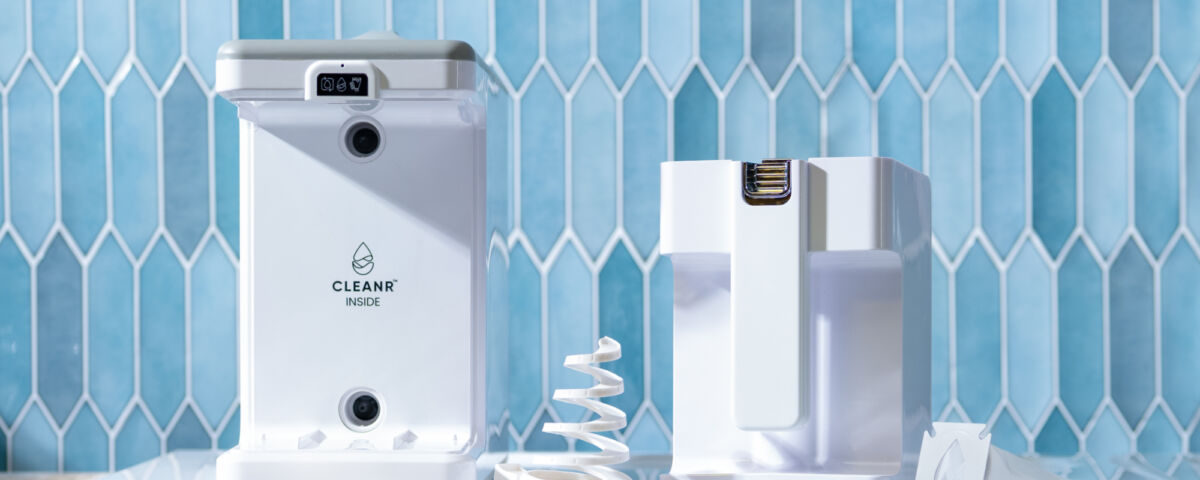
CLEANR’s Washing Machine Filter connects externally to a washing machine and filters out microplastics from washing machine wastewater. A component of the Washing Machine Filter is VORTX, a patented filtration technology that pushes 90% of microplastics from washing machine wastewater into the CLEANR Pod, CLEANR’s mechanism to capture microplastics as small as 50 microns. CLEANR’s innovation is helping to create safe water supplies by removing microplastics from our environment.
While students at Case Western Reserve University (CWRU), Max Pennington, Chip Miller, and David Dillman founded CLEANR, a private company aimed at reducing microplastic pollution. Through internship experience, the co-founders learned that few individuals were talking about microplastic pollution and potential remedies. The co-founders experimented with their idea for a microplastic filter for washing machines in the basement of their fraternity house. After having success in their home experiment, the team utilized resources at Sears think[box], a makerspace open to the Greater Cleveland and CWRU community, to create CLEANR’s patented microplastic filtration technology called VORTX. The technology used in VORTX mimics the biomechanics of a manta ray to separate microplastics from washing machine wastewater so they may be retained by the filter. By catching microplastics inside the filter, CLEANR’s technology helps stop microplastics from entering the waterways.
Pennington envisions a world where microplastic filtration technology wouldn’t simply be an optional feature for consumers, but rather a standard requirement for all washing machines. “Our final dream in washing machines is to have [CLEANR’s technology] integrated into the washing machine,” Pennington said, referring to the filter becoming as essential as safety and environmental standards in other fields. “We kind of see it like catalytic converters on a car or a seat belt in a car. It’s just the standard feature that everyone assumes will be there.”
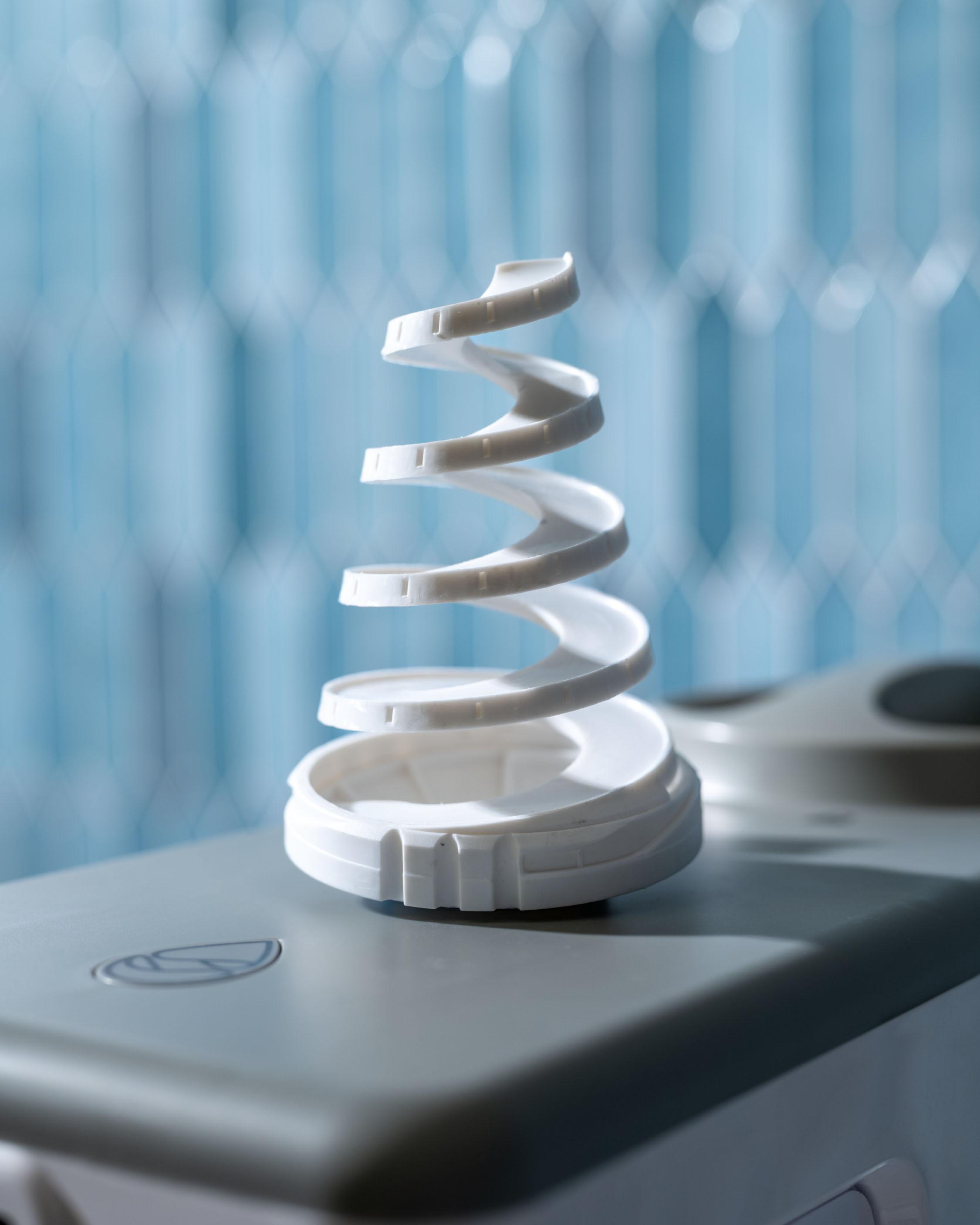
CLEANR's patented VORTX technology
The idea for CLEANR and its washing machine microplastic filter came during an internship of Pennington’s. While working on life cycle assessments to evaluate the environmental footprint of consumer goods, he found that the industry was overlooking a crucial cause of pollution: microplastics. “Plastic leakage was one thing we definitely weren’t examining,” Pennington said. “That was a category that I was kind of adding as a little touch to the internship. It was about what happens and where plastic gets out into the environment.”
He later discovered that laundering clothes is the largest source of microplastic pollution, primarily arising from synthetic fibers and protective sprays. Pennington was shocked upon learning this, saying, “It didn't really make sense at first because no one was talking about it.” As a result, the team founded CLEANR to address a gap in the market.
By targeting the largest source of microplastic pollution, CLEANR is helping to make our water supplies cleaner. On the local level, CWRU has purchased and installed 100 washing machine filters from CLEANR for washing machines on campus, thereby positioning CWRU as a pilot for other universities.
While local benefits are important, the environment is the primary and most direct beneficiary of CLEANR’s technology, especially the Great Lakes, based on its current operations. “The Great Lakes have some of the highest microplastic concentrations of any freshwater body in the world, and we can do something about it,” Pennington said. “So we always like to say we think Cleveland's ground zero in the fight against microplastics pollution. We're trying to make that a reality.” To quantify the company’s impact, CLEANR has implemented technology to track how many microplastics its filters are removing from the environment. To date, CLEANR’s filters have removed over 111 billion microplastics out of over 67,000 loads of laundry.
The social effects are no less significant, as CLEANR’s technology helps respond to rising public health concerns from microplastics. Pennington highlighted that the concern of microplastics in drinking water has recently increased by 350%, and 85% of individuals claim they are worried about microplastics in their drinking water. He said, “So I think there's a lot of appetite to solve this issue, both coming into and leaving the home, and I think because of that, we're doing a good thing, but there's also profitable revenue to be made that can return to our investors that believed in us and let us keep going on our mission to build other products that help the world.”
CLEANR acts as the blue ocean business case, demonstrating that healing the environment can be an effective way to open new markets for profit. So far, CLEANR has been able to raise over $9 million in funding and was recognized as a CES Innovation Awards® 2026 Honoree for Home Appliances, proving that CLEANR is a hard-tech innovation market leader.
CLEANR is also positioned in a market that will likely become more relevant in the near future. For instance, France recently passed a bill requiring washing machines to have microplastic filtration. This led CLEANR to create its filter as an external appliance rather than an integrated technology within washing machines. With the potential for other countries to implement similar legislation, CLEANR’s market positioning enables it to address the increasing demand for microplastic filtration systems.
CLEANR is a mission-driven company. From an environmental point of view, CLEANR’s technology is a crucial first line of defense for keeping our planet’s freshwater supplies clean. The VORTX technology inside CLEANR’s washing machine filter helps stop microplastics from entering the environment by capturing them at the source, thus preventing the accumulation of toxins in bodies of water.
On the societal level, CLEANR’s technology sheds light on how individuals themselves can aid in the fight against microplastic pollution. Pennington said, “[CLEANR’s washing machine filter] takes 15 minutes to install, it takes less than 30 seconds a week to maintain.” CLEANR’s technology is increasingly important, as Pennington emphasized the prevalence of microplastics. He said, “[Microplastics have] been found in literally every part of the body that's been tested. They're in our water, they're in our food, they're in the air we breathe. And I think people are starting to ask, ‘What can we actually do about that?’”
Moreover, their dedication to Cleveland for water tech is a boost to the local economy. Pennington is hopeful for the future of Cleveland as a manufacturing hub. He said, “Cleveland has such a unique opportunity to lead the world in the manufacturing, the prototyping and that realm of startups.”
Get stories of positive business innovations from around the world delivered right to your inbox.
Max Pennington, CEO and Co-founder
CLEANR is a startup based in Cleveland, Ohio, that focuses on preventing microplastics from passing from household appliances into the environment. The company developed its patented filtration system technology at Sears think[box] at Case Western Reserve University. CLEANR’s technology removes microplastics from water in washing machines, which is the largest source of microplastic pollution worldwide.