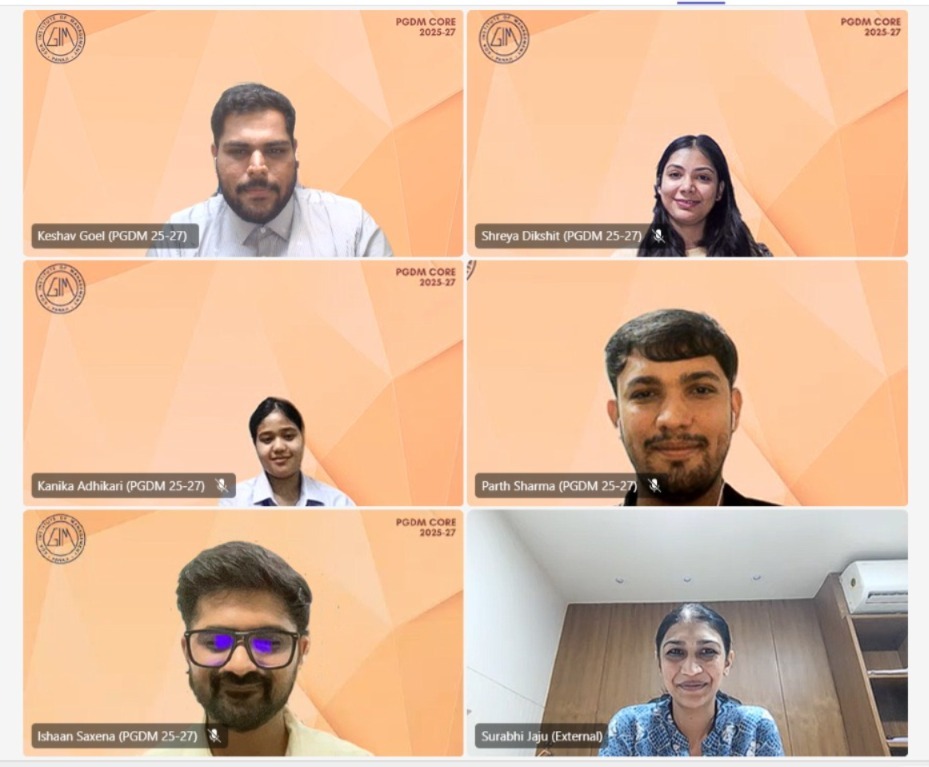

Keshav Goel

Ishaan Saxena

Parth Sharma

Shreya Dikshit
Kanika Adhikari
Goa Institute of Management

Divya Singhal


Keep this story going! Share below!
The brand Rustic Art specializes in waterless, concentrated personal care products based on natural ingredients like Neem and Tulsi. They do not follow the common market strategy, where products are predominantly water; they develop active extracts that are global and produce less waste. This, combined with the use of simple, recyclable packaging and sourcing locally, will lessen the environmental impact while making it affordable for common users. Due to this strategy, the business is aligned with UN SDGs such as Responsible Consumption and Production and, in addition, Climate Action.
The most fascinating thing that came out of the discussion was that the company challenged one of the personal care industry's simplest and weakest points: the abundant use of water in virtually all products. “Why should customers pay for water?” Most face washes and so on have water as the first ingredient, as Dr. Surabhi explained, and customers are getting mostly a diluted formulation. Rustic Art decided instead to shift to concentrated, largely waterless products, which were formulated through their own home research and development.
One of the products they mentioned in the interaction was their Neem and Tulsi face wash concentrate. It is an active-ingredient-based product, and so thick that a relatively very small quantity is required per use, and a small pack can last almost two months. That leads to a direct decrease in packaging and revisiting. Discounting is not employed to offer low prices, but rather to control costs, including avoiding flashy packaging, keeping containers basic, and spending little on branding aesthetics. Even the shipping containers are sparse and mostly made of paper, which conveys their sustainability belief system in minor operational aspects as well.
This mindset is also evident in their factory operations. They have maintained a neem tree at their Satara plant and, where feasible, use its leaves in manufacture, having an alternative source in the neighbourhood. The other feasible measure is that their packing supplier is situated just behind their premises, thus minimizing the influence of transportation and logistics.
They are utilizing AI applications in real-life applications, to write emails to consumers, to provide language support in translations, and even product images to market products rather than paying large sums of money for studio shoots, primarily to keep costs down and maintain prices constant. Thus, it is not only a product-level but also a process-level innovation.
It is a journey of complete transformation, as the solitary discipline of a PhD in environmental economics gave way to the collective rhythm of Rustic Art. Dr. Surabhi Jaju reflected, “I have done my PhD, and a PhD is one of the largest solo projects that you can undertake. So, while I was doing my PhD, first you have to learn to trust yourself, and then you end up doing a lot of things yourself.” That self-reliance became her foundation — but entrepreneurship required reinvention. “In business, you need to enable everybody else as well… business cannot be run much as a solo person. It has to be a team game.”
Her inspiration, however, began much earlier. She described her childhood as rooted in environmental action: “Waste segregation, composting, cleanliness drives — that was normal in our home.” What others call sustainability was, for her, simply upbringing. “We didn’t start Rustic Art because it was trendy. We started it because it was natural to us." She emphasized that the brand emerged from lived values, not market positioning: “Environmental consciousness was never a strategy. It was a habit.”
The shift from researcher to entrepreneur required humility and growth, “It took me a while… to figure out how to delegate, what to delegate, in what way to delegate.” Today, that discipline fuels a wider mission: “If you empower one woman with skills and confidence, you empower an entire family.” What began as a one-person pursuit has evolved into a collective movement.
Rustic Art revolutionizes the perception of business success by quantifying its growth not solely based on its revenue, but also in the degree of positive contribution to the health, society, and the environment. In line with the United Nations Sustainable Development Goals (SDGs), the company's activities help achieve SDG 3 (Good Health and Well-being) by providing toxin-free personal and home care products that reduce daily exposure to chemicals and help people live more safely.
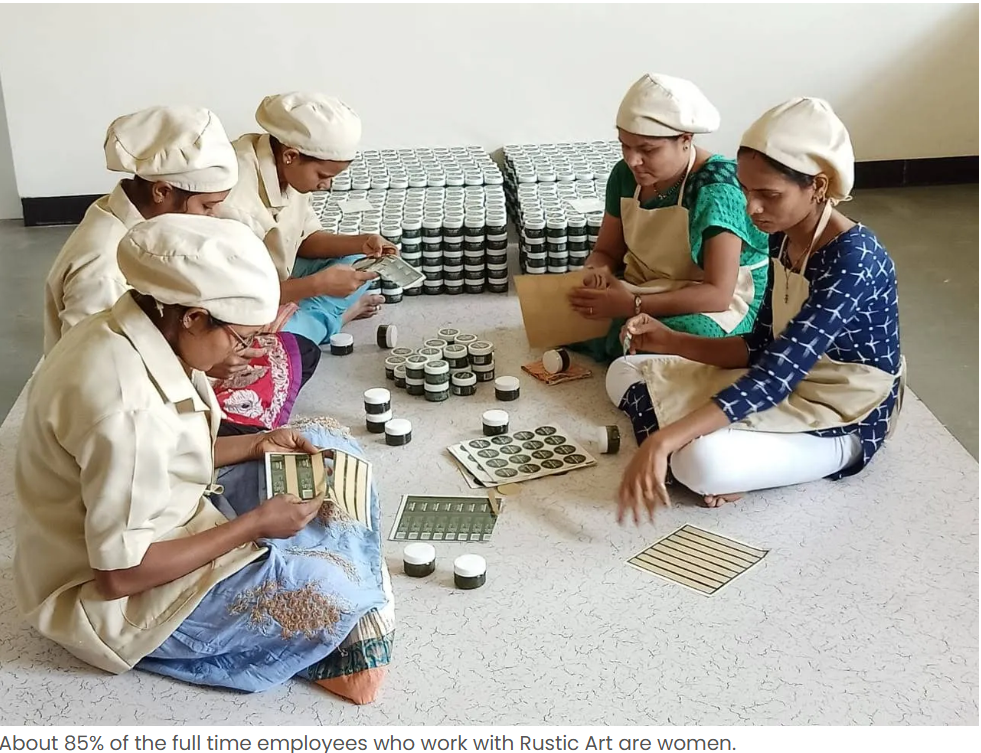
Rustic Art supports SDG 5 (Gender Equality) through its workforce policies, in which more than 80 percent of its staff are women, many of whom are first-time employees in the formal workforce. The company facilitates long-term economic autonomy by generating sustainable income, developing valuable skills, and introducing people to digital and AI technologies.
The core of the Rustic Art model focuses on innovation, which helps meet SDG 9 (Industry, Innovation and Infrastructure) by producing within the company and creating waterless, concentrated products that defy standard production norms. These technologies have a direct impact on SDG 12 (Responsible Consumption and Production) by reducing water consumption, packaging, and transportation emissions. Environmentally, Rustic Art’s solar-powered manufacturing facility becomes net positive in energy production during the summer months, reducing reliance on conventional energy sources.
Last but not least, Rustic Art plays a part in SDG 13 (Climate Action) through creating low-waste supply chains, sourcing locally, and reducing its carbon footprint through efficient logistics and use of resources. Rustic Art has shown that impact-led innovation can create resilient, scalable, and future-ready businesses by staying bootstrapped, even in times of crisis, as seen during the COVID-19 crisis.
Because sustainability is not treated as an add-on but is ingrained into every step of the business—from formulation to packaging and distribution — each decision is carefully evaluated for its long-term impact, making the business model profitable and scalable. Today, approximately 70% of the revenue is generated from concentrated waterless products. The products last up to three times longer than conventional liquid products. This increases customer perceived value while reducing production and logistic cost. The primary sales channel is online, which enables nationwide reach and efficient scaling.
Customer Retention, the crux of any sustainable business model, naturally occurs once the product's effectiveness is experienced. Despite longer product usage cycles, the brand achieves nearly 60% repeat purchase, reflecting strong product performance and value-driven brand loyalty. Customers may initially discover the brand for its effectiveness but stay because of their trust in the brand's values and practices.
Most products have water as their first ingredient and are largely water-based. Rustic art products contain only actives. The formulation strategy reduces packaging, transportation weight and cost per unit, improving overall operational efficiency. AI-enabled marketing and minimal packaging further reduce the cost.
Strategically, integrating sustainable practices across all operations enhances long-term business stability, and the unique positioning has unlocked new partnerships, institutional orders, and export orders. At Rustic Art, sustainability is not just about avoiding plastic; it's about how materials are used, consumed, and disposed of. While it may create certain operational challenges, Rustic Art takes pride in finding solutions rather than making compromises, as the impact matters more than short-term gains for the people associated with the brand.
Rustic Arts believes that the only thing we share with our future is the planet we live on and the values we pass on. The practice aligns directly with their mission. Their focus is on practical, context-based choices rather than treating sustainability as an extreme or idealistic act. It focuses on how small, incremental steps can create lasting impact. Their waterless biodegradable formulation reduces water usage, packaging intensity, and downstream chemical pollution. And its solar-powered, zero-liquid-discharge manufacturing facility helps in minimizing environmental footprint.
The company also advocates for social impact by employing 80% women workforce. They enable independence and skill-development in tier 3 cities. Employees are trained in digital tools and AI, which helps in overcoming the language barrier and increasing productivity. As Surabhi notes, “Young girls... are now learning AI tools and using them every day. This directly supports gender equality and decent work.
Rustic Art also focuses on behavioural change by packaging their products using locally sourced newspaper instead of beehive paper. The company uses its blog to promote conscious consumption. It normalizes low-impact living rather than positioning sustainability as a luxury, by making sustainable choices affordable and practical. Together, all these initiatives demonstrate how small, system-level innovations can create scalable environmental benefits, empower communities, and shift everyday consumption towards sustainability.
Get stories of positive business innovations from around the world delivered right to your inbox.

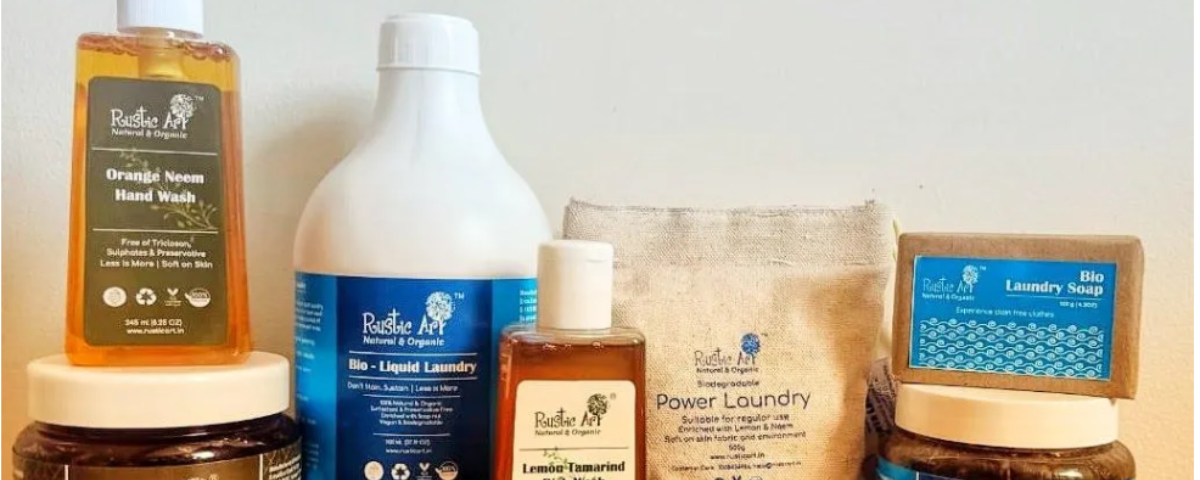
Rustic Art manufactures beauty, personal care, and home care products used “from the time we wake up to the time we go to sleep,” including hand wash, face wash, soaps, creams, lotions, serums, kids and baby products, and cleaners such as dishwashing and floor cleaners. These products are formulated with traditional Indian ingredients (such as neem) instead of toxic chemicals, are cruelty-free, and are designed to be better for both users and the environment.