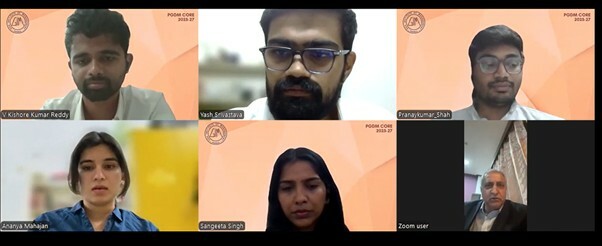

Ananya Mahajan

Yash Srivastava
Sangeeta Singh
Pranaykumar Shah
V Kishore Kumar Reddy
Goa Institute of Management

Divya Singhal


Keep this story going! Share below!
J&K Industries is a government-affiliated silk manufacturing organisation in Jammu & Kashmir that produces silk yarn and fabrics through fully integrated in-house processes. By installing Effluent Treatment Plants (ETPs) to recycle wastewater, adopting solar energy, upgrading infrastructure, and sustaining 10,000–20,000 local cocoon growers, the company contributes to SDG 9 (Industry, Innovation and Infrastructure), meanwhile also contributing to SDG 12 (Responsible Consumption and Production) and SDG 8 (Decent Work and Economic Growth).
Who:
In the last few years, J&K Industries has adopted more environmentally friendly methods due to stricter rules, higher energy costs, increased global competition, and greater public awareness of environmental issues.
What:
The main new thing is that Effluent Treatment Plants (ETPs) are now part of its dyeing and finishing units. Before, the wastewater from dyeing, reeling, and finishing was sent down the drain. The new ETP systems treat and reuse wastewater throughout the production cycle, reducing water waste and environmental damage. Also, the company has started solar panel projects that aim to lower dependence on electricity and lower the operational energy costs. Betterment in infrastructure, modern dyeing machines, improved retail strategies, and design innovation also support this transition toward sustainable industrialisation.
When:
In the last few years.
Where:
In its dyeing and finishing units and across its production cycle.
How:
Ultimately, the organisation wants to maintain long-term competitiveness while also ensuring that industrial growth aligns with sustainable development. This approach directly supports SDG 9 (Industry, Innovation and Infrastructure) by upgrading manufacturing systems and promoting sustainable industry. It also contributes to SDG 12 (Responsible Consumption and Production) through water and energy recycling and energy efficiency, while advancing SDG 8 (Decent Work and Economic Growth) by sustaining the livelihoods of 10,000–20,000 local cocoon growers and in-house weavers who are part of the value chain.

J&K Industries' move toward sustainability was the result of a gradual realisation driven by experience, industry changes, and global developments. Mr Satish Thaploo's more than 30 years of experience in the handloom and textile industry helped the company rethink its approach to innovation and responsibility.
He said that "leadership used to be explained as dictatorship" when he thought about how leadership has changed over time. But now, being a leader doesn't just mean taking care of things. You have to deal with all the stress, find ways to make the most of limited resources, and help your teams get better at what they do. This change in thinking enabled sustainability to be included in the decision-making process.
Environmental awareness and changes in how the company operates have changed things inside even more. He said, "Regulations have gotten stricter over the past decade or so, and now sustainability is a top priority." The situation worsened because energy costs were high and global competition was growing. He said, "Globalization of markets has definitely made things more competitive." For example, silk from China has become a competitor in Indian markets. These things have definitely changed our approach to sustainability.
His idea of success doesn't just include money, though. He says, "Success is not only financial growth." It also includes caring for the environment, generating new ideas, helping employees grow, and making a difference in the community.
This new understanding of business responsibility led the company to invest in improved wastewater treatment systems, renewable energy research, and infrastructure upgrades. So, sustainability didn't come about because of rules; it came about because it was a strategic necessity, grounded in long-term thinking and ethical leadership.
Over the past three to four years, Jammu & Kashmir Industries, under the leadership of Mr Satish Thaploo, began modernising its operations with a stronger focus on environmental sustainability. The key innovation was the installation of Effluent Treatment Plants (ETPs) within its dyeing and finishing units, along with investments in improved wastewater treatment systems, renewable energy research, and infrastructure upgrades. These initiatives were introduced across its production facilities as part of a broader strategy to align industrial growth with long-term environmental responsibility.
In the short term, the innovation helped the company comply with stricter environmental regulations and improve operational efficiency. This new understanding of business responsibility led the company to invest in better treatment systems, renewable energy research, and infrastructure updates. So, sustainability didn't come about because of rules; it came about because it was a strategic necessity, grounded in long-term thinking and ethical leadership.
The modernisation has made the company more competitive in the long run. The company did better in stores and got more customers by creating new designs and adding value to its silk products. The move toward more environmentally friendly practices has also made the company appear responsible and forward-thinking. The project shows a commitment to long-term growth that balances making money with caring for the environment and the community. This shows that sustainability was adopted as a strategic necessity, grounded in long-term thinking and ethical leadership.
When we spoke with Mr Satish Thaploo, one thing became clear: the sustainability initiatives at J&K Industries were not introduced solely for compliance, but to strengthen the business in a practical sense. The installation of Effluent Treatment Plants (ETPs) has enabled the organisation to treat and reuse wastewater generated by its dyeing and finishing units. Because of this, reduced dependency on freshwater, decreased environmental risk, and improved resource efficiency have occurred. In a water-intensive industry like this one, recycling wastewater is important for long-term cost control and regulation.
Additionally, installing solar panels over the next few years will lower electricity costs, which might help stabilise rising energy costs and operational margins. Because the business moved beyond traditional bulk silk production by introducing embroidered designs, modern printing techniques, and expanded retail offerings, it diversified income streams and increased retail market penetration. By responding to evolving consumer preferences, improved sales performance and enhanced ability to compete with international producers have occurred.
Infrastructure upgrades and modern machinery have also improved production quality and consistency, strengthening brand credibility in both regional and competitive markets. Hence, as the business implemented sustainable infrastructure, retail growth, and product development, increased cost efficiency, less operating risk, diversified revenue base, and better adherence to financial stability have been experienced without losing social and environmental obligations.
Wastewater recycling is to be performed through Effluent Treatment Plants (ETPs) and the modernisation of machines to make the silk production process resource-efficient and sustainable. These have been enforced in the firm's dyeing and finishing departments and in its silk manufacturing plants to reduce mental damage and still generate maximum output. This innovation is good for the environment because the silk production process is more resource-efficient and more environmentally friendly. In the past, wastewater was directly released into the atmosphere, posing a threat to surrounding water sources. Nonetheless, today wastewater is recycled and reused, as Effluent Treatment Plants (ETPs) have been established. This reduces water pollution, conserves freshwater resources, and promotes sustainable industrial practices. The implementation of solar panels will also reduce reliance on conventional electricity, which is expensive and environmentally destructive. Upgrades to machinery and production processes also minimise waste. The maximisation of efficiency has significant social benefits by promoting sustainable livelihoods in rural areas. By enhancing the silk production value chain from cocoon sourcing to fabric production, the innovation helps sustain livelihoods for 10,000 to 20,000 cocoon farmers and weavers. Upgrades in design, embroidery, and retail process enhancements have increased demand for the product, improving employment and income sustainability in the region. This makes sure that traditional silk production skills are maintained while meeting the needs of the modern market.
In conclusion, the innovation shows that sustainable production processes can provide environmental as well as social benefits. Through reducing pollution, conserving resources, improving efficiency, and promoting sustainable livelihoods, the innovation guarantees long-term social benefits. It shows that sustainability also builds sustainable communities, improving economic resilience, and ensuring sustainable industrial development in the future.
Get stories of positive business innovations from around the world delivered right to your inbox.
J&K Industries is a government-owned silk manufacturing organisation based in Jammu & Kashmir. The company functions across the entire silk value chain, including sourcing of cocoons from local cocoon growers, reeling silk yarn, weaving fabrics, dyeing, finishing, and selling silk and woollen products. By including entirely in-house production processes, the organisation sustains many local cocoon growers and weavers side by side, maintaining traditional craftsmanship. Through modernization and product innovation, J&K Industries aspires to strengthen the local industry, generate employment, and maintain competitiveness in global markets.