

Annemijn Catrysse
Lavinia Neyens
Janne Baumans
Janne Baumans
Bjorn Fontaine

Universiteit Hasselt

Ruveyda Kelleci


Keep this story going! Share below!
At Tienen’s Sugar Refinery, sustainability is viewed as more than just reducing CO2 emissions. The company is committed to lowering water consumption and emissions, while also building long-term partnerships with its farmers. Together, they explore the agriculture of the future, including fertilization options and plowing methods. In this way, sustainability becomes both an ecological and a social priority. This vision is explained by Erwin Boonen, Director of Raw Materials at Tienen’s Sugar Refinery.
The sustainability innovation at Tienen’s Sugar Factory aims to become increasingly climate-friendly. Together with the Südzucker Group, the refinery is striving toward climate neutrality by 2050, recognized by the Science Based Targets Initiative (SBTI). This is reflected in their mission: producing high-quality sugar products that contribute to sustainable and responsible food production, driven by continuous innovation and improvement. Sustainability at Tienen begins with the zero-waste principle and the use of combined heat and power (CHP), which ensures optimal heat and energy use. This has made the factory largely energy self-sufficient.
CO2 emissions are categorized into scope one, two, and three. Since 2021, the focus has been on reducing scope three emissions, which mainly originate from sugar beet cultivation and represent two-thirds to three-quarters of total emissions. The central innovation is not a single product but a new method of engagement: a voluntary, incentive-based program encouraging sustainable practices among the 3,400–3,500 independent farmers they work with, rather than imposing rules. This initiative entered an intensive phase in 2021, evolving from a small Climate Farming Group of fifteen “pioneers” into a large-scale project. To bridge the gap between these pioneers and the average farmer, two demo platforms were created: one in Tongeren (Flanders) focusing on soil cultivation, and one in Eghezee (Wallonia) focused on precision technology. These platforms engage both farmers and customers and create broader interest in agricultural innovation.
Tienen’s Sugar Factory also contributes to several Sustainable Development Goals. Investments in innovative technologies, such as the vertical diffusion tower (2023) and an advanced industrial heat pump (2025), save 6,000 tons of CO2 and 150,000 cubic meters of water each year. This supports SDG 13 (Climate Action) and SDG 6 (Clean Water and Sanitation). Their technological progress reflects SDG 9 (Industry, Innovation, and Infrastructure). The zero-waste approach fully reuses the 75 percent water content of sugar beets, and leftover pulp becomes animal feed, aligning with SDG 12 (Responsible Consumption and Production). The refinery also works with farmers to protect soil health and biodiversity (SDG 15 – Life on Land). These achievements are made possible through partnerships, such as those with farmers and the Südzucker Group, reflecting SDG 17 (Partnerships for the Goals). As Boonen stated, “Alone we go faster, but together we go further.”
Although innovation at Tienen’s Sugar Factory is focused on measurable goals like scope three CO2 emissions, the deeper inspiration is the need to preserve and future-proof the agricultural sector. This raises ongoing questions such as “What will tomorrow look like?” and the need to respond to climate and market changes. The refinery places great importance on its partnership with farmers. Instead of treating agriculture as merely a supply contract, they intentionally pursue sustainability together. Boonen explained, “We believe it is important that we undertake this quest together. And that we do not just sit back and say, ‘Agriculture is not my responsibility, I will just buy a product.’”
The partnership program was inspired by the unique challenge of scope three emissions, which cannot be solved through factory or energy changes alone. It requires conviction and cooperation, making progress both challenging and gradual. Despite this, motivation is strong. As Boonen noted, “Ultimately, one-third of our farmers are participating with at least one action. And that is huge. To be honest, I find that incredibly inspiring and motivating.”
The impact of Tienen’s Sugar Factory can be seen in several areas. The most immediate short-term effect is the high farmer participation rate. Despite the administrative effort required and the timing during farmer protests, engagement was strong. Another key impact is the growing interest from B2B customers. Whereas agriculture was once overlooked, major customers now proactively request visits to the demo fields. Boonen shared: “In the spring of this year, customers called our salespeople to ask, ‘When is your sustainability day? Because I want to block that day. I want to be there.’”
In the short term, the refinery aims to support farmers, since beet cultivation is essential for its operations. In the long term, they aim to future-proof beet cultivation and their own production by exploring reduced chemical use and mechanical alternatives. The six-point program and quantitative questionnaires now allow the company to calculate the CO2 footprint per ton of sugar per grower. This system enables farmers to voluntarily participate in subsidized actions, such as reducing mineral nitrogen use. The core innovation lies in data collection, which includes a qualitative “green card” audit and a detailed quantitative questionnaire, allowing them to calculate an accurate carbon footprint for each participating farmer.
In the long term, they want to look at how they can make the things they are so dependent on in their production and beet cultivation more future-oriented. This means using fewer chemical products and switching to mechanical solutions. They are also committed to creating a measurable basis for CO2 reduction. Thanks to the six-point program and quantitative questionnaires, the company can now calculate the CO2 footprint per ton of sugar per grower. This program enables all farmers to voluntarily participate in subsidized actions, such as reducing the use of mineral nitrogen. The innovative core of the program lies in data collection: it uses a “green card” for a qualitative audit of the farm and a detailed quantitative questionnaire about the beet cultivation process. This data is entered into a specialized tool to calculate an accurate carbon footprint per ton of sugar for each participating farmer, a measurable step towards a more sustainable world.
Financial pressures remain, as sustainability efforts come with high costs and the sector is competitive. According to the director, the overarching long-term goal is simply to “still be here tomorrow” as a company and as a sector. This long-term view sets Tienen apart from companies focused only on quarterly results.
Although the innovation does not yet generate direct additional income because the market is not prepared to pay a premium, it provides essential business benefits. Sustainability requires investment, and Tienen’s Sugar Factory is investing in heat pumps, extraction towers, and other technologies. These reduce water use and energy needs, which lowers CO2 emissions and reduces future sustainability risks, although they also increase costs.
Partnership and collaboration are considered essential for progress. By proactively launching this large-scale sustainability program with thousands of Belgian farmers, the refinery strengthens its market position, and company culture, builds trust, and reinforces customer relationships.
The innovation also affects staff retention. The director explained that retaining good employees is even harder than attracting them. He hopes this sustainability mission will help with retention: “And I hope, I think, but above all I hope, that it will mainly help us to retain people.” Sustainability is also defined internally as the way people treat one another, which contributes to well-being and positive company culture.
Externally, the innovation has created a new form of customer engagement and effectively a new service. While B2B customers were previously uninterested in the agricultural phase, major players are now actively requesting visits to the demo fields. Through the six-point program and its data collection system, Tiense Suiker can present “hard data” and offer customers something that did not exist before: sugar linked to a verified, significantly lower carbon footprint. As Boonen emphasized, they can now make available “a quantity of so many tons of sugar with such a significantly reduced carbon footprint.” This strengthens relationships with strategic customers and positions the company for the future.
Despite these successes, the economic picture remains challenging. Determining volumes and pricing is not always straightforward. However, growing customer interest shows that the sector is increasingly “on board with sustainability.” The competitive advantage for Tienen’s Refinery lies in its ability to demonstrate measurable progress. Customers choose this producer because they can rely on verified sustainability outcomes. With the current data, the company can confidently offer sugar with a significantly reduced carbon footprint. As Boonen summarized, “We don’t sell talk, we sell hard data.”
The innovation developed by Tiense Suikerraffinaderij delivers direct benefits for both the environment and society. This initiative, which has been under intensive development since 2021 and was launched nationwide in Belgium at the end of 2023, focuses primarily on measurably reducing the carbon footprint of agriculture (scope three). Environmental benefits are achieved because the six-point program provides farmers with financial incentives to adopt practices such as reducing the use of mineral nitrogen, a major source of greenhouse gases. Farmers complete both a qualitative and a quantitative audit. The qualitative audit allows them to compare their sustainability performance with other farmers and with the climate farming group.
The climate farming group is a collaboration with BENEO and Puratos. They have joined forces because they believe more can be achieved together. They support Belgian farmers in sustainable agricultural practices and promote principles that improve soil health and reduce environmental impact. The project focuses primarily on knowledge exchange between farmers, ensuring that the innovations remain economically viable. The quantitative audit concerns beet cultivation itself and the steps in the beet process. With this data, the sugar factory can estimate CO2 emissions and generate accurate sustainability figures.
In addition, the program addresses broader environmental aspects. Although CO2 is the main focus because it is measurable, biodiversity is also actively supported. Through the program, 44 hectares of flower strips have already been sown by participating farmers. Research on the demo platforms in Tongeren and Eghezee explores techniques such as non-inversion tillage (including direct sowing), which improves soil health and reduces erosion.
From a social perspective, the greatest benefit is the support for the local agricultural sector. By not only setting expectations for growers but also strengthening them through knowledge sharing, Tiense Suiker helps ensure the long-term economic viability of these farms. The demo fields serve as an important educational hub, not only for farmers but also for customers, the public, and even government ministers. This helps translate the often abstract concept of sustainability into practical understanding and bridges the gap between agriculture and society.
Get stories of positive business innovations from around the world delivered right to your inbox.
Erwin Boonen, Director of raw materials

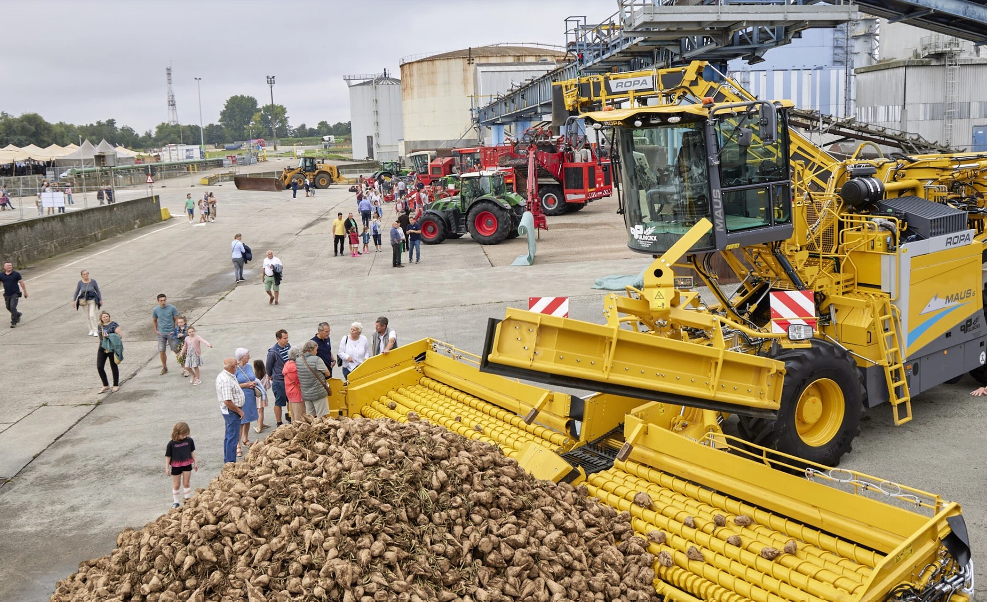
Tienen's Refinery processes sugar beets into different kinds of sugar that can be used in other food processing companies and also for final consumers. They focus on a ‘zero-waste’ principle were they valorises residual products and investments in environmentally friendly production techniques.