

Simran Kaur

Universiteit Hasselt

Ruveyda Kelleci


Keep this story going! Share below!
Vandemoortele is a Belgian family-owned food company founded in 1899 and today one of Europe’s leading producers of bakery products, margarines, and plant-based food solutions. Guided by its core value of respect, the company has made sustainability a central part of its identity, not as a marketing tool, but as both an ethical conviction and a strategic direction.
To better understand how this ambition is translated into practice, we interviewed Marc Croonen, Chief Human Resources, Sustainability and Communication. In this role, he drives the company’s sustainable transformation by shaping strategy, guiding teams, and ensuring that both people and the planet remain at the heart of decision-making.
Vandemoortele develops high-quality food products for retail, food service, and industrial customers across Europe. The company actively contributes to more sustainable food systems by reducing its environmental footprint, sourcing raw materials responsibly, and promoting healthier, plant-based alternatives. As Marc Croonen explained, “Our goal is to offer tasty and sustainable products that bring people a pleasant moment, while respecting both health and the planet.”
This approach directly supports several United Nations Sustainable Development Goals, including SDG 12 (Responsible Consumption and Production), SDG 13 (Climate Action), SDG 7 (Affordable and Clean Energy), SDG 3 (Good Health and Well-Being), and SDG 2 (Zero Hunger).
Innovation lies at the heart of Vandemoortele’s success. Through its in-house R&D centres, the company continuously develops new products that respond to evolving consumer trends such as convenience, health, and sustainability. One clear example is the development of Baker’s Low Sat, a margarine with significantly reduced saturated fat while maintaining taste and baking performance.
Marc Croonen emphasized how closely innovation and sustainability are linked within the company, noting: “We try to make our products healthier without losing taste. That’s our main challenge and also the base of all our innovations.”
Innovation also extends beyond products to processes and operations. Within the bakery division, Vandemoortele regularly introduces frozen products that can be prepared with minimal effort, helping customers save time and labor while reducing waste. This demonstrates how the company approaches sustainability across the entire value chain. “Everyone in the company is asked to contribute to sustainability from their own role,” Croonen explained. “R&D works on healthier recipes, purchasing focuses on green energy, and HR works on diversity and inclusion.”
In addition, Vandemoortele annually organizes the Plant-Based Food Awards, highlighting both internal and external innovation projects related to plant-based foods. The company also works on improving raw-material traceability, reducing packaging waste, and continuously identifying alternatives with a lower ecological footprint.
Vandemoortele was founded in 1899 by Constant and Adhémar Vandemoortele in Izegem, Belgium, originally as an oil mill producing oils and fats for local soap and animal feed industries. What began as a family business focused on quality and craftsmanship grew into a major player in the European food sector. Despite its growth, the company’s core inspiration has remained consistent: combining good taste, quality, and innovation.
In recent years, this inspiration has increasingly translated into a focus on plant-based foods. As more consumers seek healthier and more sustainable alternatives, Vandemoortele has responded by adapting its product portfolio. This shift stems directly from the company’s core values. “One of our core values is respect, respect for people and respect for the planet. That’s where it all starts,” Croonen explained.
Guided by this principle, the company aims to minimize environmental impact while continuing to deliver high-quality, enjoyable food. Whereas animal fats were primarily used in the past, vegetable-based ingredients are now increasingly applied without compromising taste. In this way, Vandemoortele stays true to its heritage while adapting to modern, sustainable eating habits.
Vandemoortele’s impact extends beyond regulatory compliance and reflects a deep-rooted commitment to sustainability. The company creates measurable impact across the environment, public health, climate action, and the wider food industry, demonstrating that economic performance and positive societal impact can coexist.
From an environmental perspective, Vandemoortele is one of the few food companies committed to the Science-Based Targets initiative, aiming to limit global warming to 1.5°C. With total CO₂ emissions of 2.37 million tonnes, the company has approved reduction targets of 42% for Scope 1 and 2 emissions and 30.3% for Scope 3 emissions. This is particularly significant, as 98.1% of emissions originate from raw-material sourcing, including vegetable oils, wheat, cocoa, and dairy.
Operational improvements further support this effort. Since 2020, Vandemoortele has used 100% green electricity and continues to improve packaging by transitioning to recyclable mono-materials.
On the social side, the company adopted a conscious nutrition strategy that encourages R&D teams to reduce sugar, salt, and saturated fats while increasing beneficial nutrients such as omega fats. Since 2024, Vandemoortele also sources only 100% traceable palm oil, supporting responsible consumption and decent working conditions throughout its value chain.
For Vandemoortele, sustainability is both an ethical choice and a strategic one. One of the company’s core values is respect for people, the planet, and society. Acting in line with this value means, as Croonen explained, “being able to look in the mirror and know you are doing the right thing.”
This ethical commitment also delivers tangible business advantages. Sustainability differentiates Vandemoortele from competitors, strengthens its brand reputation, and aligns with growing consumer expectations. Retailers and partners increasingly value suppliers with strong sustainability credentials, contributing to long-term competitive advantage.
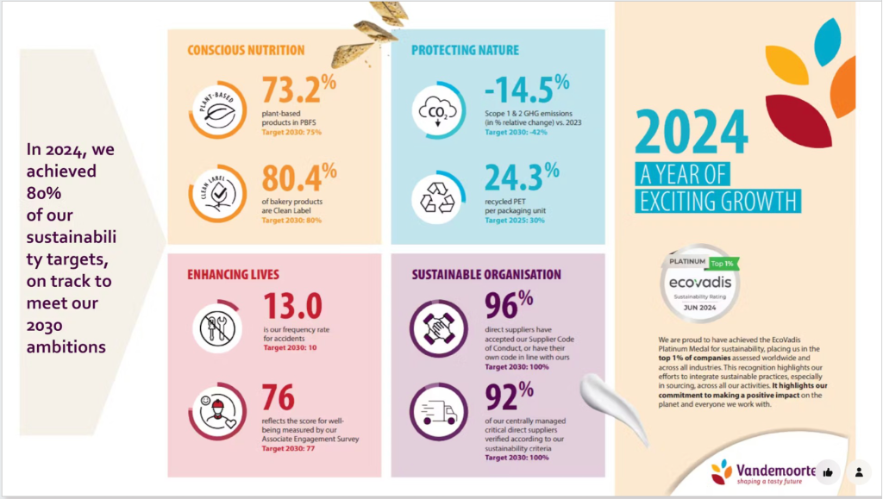
Sustainability also drives efficiency and cost savings. “Not all sustainability actions cost money. Some actually save money,” Croonen noted. Improved energy efficiency led to a 14.5% reduction in Scope 1 and 2 emissions in 2024 compared to 2023, lowering energy costs and reducing exposure to volatile fossil fuel markets.
Additionally, Vandemoortele’s focus on plant-based innovation supports growth. Plant-based products now account for 73.2% of the portfolio, nearing the 2030 target of 75%. Clean-label bakery products represent over 80% of offerings, reinforcing market leadership. Sustainability also improves employee engagement. Internal surveys show a well-being score of 76, reflecting pride, motivation, and loyalty among staff.
Vandemoortele’s sustainability journey focuses on reducing its environmental footprint while creating positive impact across the value chain. The company recognizes its responsibility to act on climate change and has embedded concrete measures to reduce CO₂ emissions and promote sustainable production.
Within its own operations, Vandemoortele invests in renewable electricity, biogas-powered ovens, and vehicle electrification. Many trucks already operate on biofuels, with several fully electric vehicles in use, demonstrating how industrial food producers can decarbonize operations.
However, most emissions originate upstream. “About 98% of our footprint comes from ingredients we buy,” Croonen noted. To address this, Vandemoortele collaborates with farmers and suppliers on regenerative agriculture, low-emission dairy sourcing, and deforestation-free palm oil. These actions protect biodiversity while reducing climate impact.
Socially, the company’s sustainability strategy strengthens employee engagement and supports farmers transitioning toward more sustainable practices. At the same time, Vandemoortele acknowledges the challenge of affordability. Through transparent communication and labeling, the company helps consumers make informed choices, reinforcing its belief that sustainability is the future of the food industry.
Get stories of positive business innovations from around the world delivered right to your inbox.
Marc Croonen, Chief HR, Sustainability, EHS & Communication

Vandemoortele is a leading European food company specializing in bakery products, margarines, oils, and fats. Founded in Belgium, it operates as a family-owned business with production sites and sales offices across Europe. The company supplies both retail and professional markets, focusing on high-quality ingredients and ready-to-bake solutions. Vandemoortele is known for combining culinary expertise with sustainable and responsible business practices.