

Semsettin Kaya
Zahra Boumjdoul
Seppe Jans
Esat Guney

Uhasselt

Ruveyda Kelleci


Keep this story going! Share below!
The organisation ‘De Springplank’ in Flanders combines a social mission with a successful economic model. Through a network of thrift stores and innovative bicycle services, they not only help the environment by giving things a second life, but also provide meaningful jobs to hundreds of people who struggle to find work in the regular labor market.
The director describes their work and vision as “It's not so much an innovation in technology, but rather in people's mindset.” They want to show people that used items still have significant value. This innovation is proof that a company can be both economically sound and deeply social.
This story is based on an interview with Stefan Coenen, director of De Springplank, conducted on October 13, 2025, at Okazi Hasselt.
The core innovation of De Springplank lies in its model of the ‘customized company’. This is not a standard company focused on maximum profit, nor is it a pure charity. It is an organization with a dual bottom line: economic and social well-being.
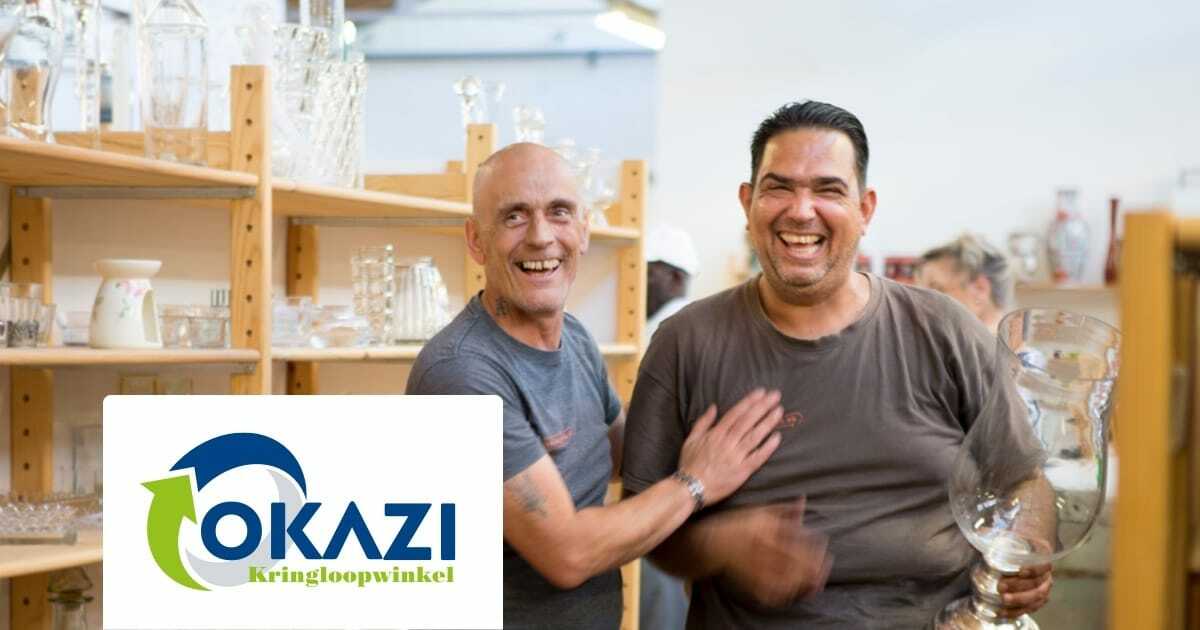
De Springplank employs around 250 people who, for various reasons such as needing structure, sensitivity to stress, or a history of addiction, are ‘distant from the labor market’. To finance this employment, the Springplank runs two major economic branches. The first and best known is ‘Okazi’, the recycling activity. This involves collecting, sorting, and selling second-hand goods across four stores.
The second, and more recent innovation, is the branch focused on sustainable mobility. This started as a way to diversify income and to offer other types of jobs. This branch now includes bicycle maintenance points, a successful bicycle rental service (such as ‘Biking through the Water’ in Bokrijk, Genk), B2B e-bike assembly for bicycle brands, and the ‘orphan bicycle’ project. What is unique is that the economic activity (such as bicycle assembly) is entirely designed around the social mission. As the director states: “It is social because we work with those people... but it is also economics.”
The inspiration for De Springplank's continuous innovation stems from a pragmatic necessity. The director, who himself joined the organization only recently, explains that “budget” is one of the organization's biggest challenges. In a climate where government subsidies are under pressure and uncertain, the organization feels a strong motivation to strengthen its own “economic activities.” The expansion of the entire bicycle branch was a direct response to this challenge. It was a strategic choice to reduce dependence on subsidies while simultaneously tapping into a new source of employment.
However, inspiration also comes from outside. A perfect example is the ‘orphan bicycle’ project. Cities such as Genk and Hasselt struggled with abandoned bicycles spoiling public spaces. De Springplank saw this not as a nuisance, but as an opportunity. They offered to collect these bicycles, strip them for parts, or repair them into ‘new’ bicycles. These are then sold at comparatively low prices at bicycle fairs.
This project solves a problem for the city, creates jobs, recycles materials, and helps people on a low budget to get a bicycle. It demonstrates the core motivation: turning problems into social and ecological opportunities.
The impact of De Springplank is accurately measured using clear KPIs (Key Performance Indicators) and can be felt on three levels. Firstly, there is the ecological impact: the company is a driving force behind the circular economy. Every year, they collect at least 1.4 million kilograms of items. Of this, approximately 799,000 kilograms are effectively resold and given a second life, keeping material out of the waste stream.
Secondly, there is the social impact, which is the actual core objective. De Springplank offers 250 people meaningful, paid jobs. This not only provides them with an income but also structure, training, and a sense of self-worth. The director emphasizes the value of this: “These people are given a chance to feel meaningful and dignified.”
In addition, the model affects customers: low prices allow people on limited budgets (such as students or people living in poverty) to buy essential items, such as furniture, clothing, or a bicycle. Finally, there is the business impact: the model is “healthy.” About half of the income comes from subsidies, but the other half is generated entirely by successful economic activities. This proves that their social and ecological mission is also economically sustainable.
The economic model used by De Springplank yields considerable benefits for the company, primarily in terms of financial resilience and diversification. By not relying exclusively on subsidies, but actively generating around 50% of its own income, De Springplank is building up a crucial buffer against political or economic uncertainty.
The strategic decision to develop a full bicycle division alongside the thrift stores was a textbook example of smart diversification. This opened up entirely new markets: from tourism (bicycle rental) and B2B services (e-bike assembly) to government partnerships (the ‘orphanbycicles’-project). This spreads the risk and creates multiple stable income streams.
Another unique advantage is their ‘human capital’. Although the employees need intensive guidance (the ‘customization’), they often possess unique, practical skills that might remain untapped in a regular company. The director admires the bicycle repairers who “can make a beautiful new bicycle out of three old ones”. This craftsmanship and creativity become a tangible product.
Finally, their ‘supply chain’ is unique: the raw materials (donated goods) are essentially free, so the focus is not on maximizing profit margins, but on generating sufficient cash flow to pay the 250 wages.
The benefits to society and the environment are profound and twofold. In terms of the environment, De Springplank is a powerful driver of the circular economy. By collecting 1.4 million kilograms of goods annually and selling 800,000 kilograms of that, the lifespan of products is drastically extended, and the waste mountain is significantly reduced. This saves raw materials and reduces CO2 emissions. Projects such as refurbishing ‘orphan bicycles’ also contribute to a cleaner streetscape and promote sustainable mobility as an affordable alternative.
The social benefits are even greater. De Springplank creates 250 jobs for people who are often left out of the regular economy. This is more than just employment; it is an investment in human dignity. It offers structure, an income, and the opportunity to develop skills. As the director notes, “there is a great deal of talent in people that we as a society perhaps underutilize today.”
In addition, the organization makes quality goods accessible to everyone, including people on low incomes. They combat poverty by creating affordable, decent bicycles, winter coats, and dining tables, thereby fighting social exclusion.
Get stories of positive business innovations from around the world delivered right to your inbox.
Stefan Coenen, Director

Okazi is a thrift store that offers a wide range of second-hand items that people no longer need. In addition, the organization is committed to sustainability through various initiatives, including bicycle recycling and rental services.
Okazi's mission is to provide tailored work and support to people who have more difficulty finding a job in the regular labor market.