

Sophie Schmid
Sem de Keijzer
Teun van Pelt
Sadeer Shaya

University of Guelph-Humber

Avans University of Applied Sciences
P Prabhu


Keep this story going! Share below!
Located in the heart of the Alps, MCI – The Entrepreneurial School® has become a forward-thinking institution where sustainability is not only taught but practiced throughout university life. Supported by its Centre for Responsible Management & Social Impact, MCI integrates the UN Sustainable Development Goals (SDGs) into teaching, research, operations, and student initiatives. As Regina Obexer, Head of the Centre, noted, preparing students for a rapidly changing world requires more than technical expertise; it demands ethical judgment, critical and systemic thinking, and open discussion about global challenges.
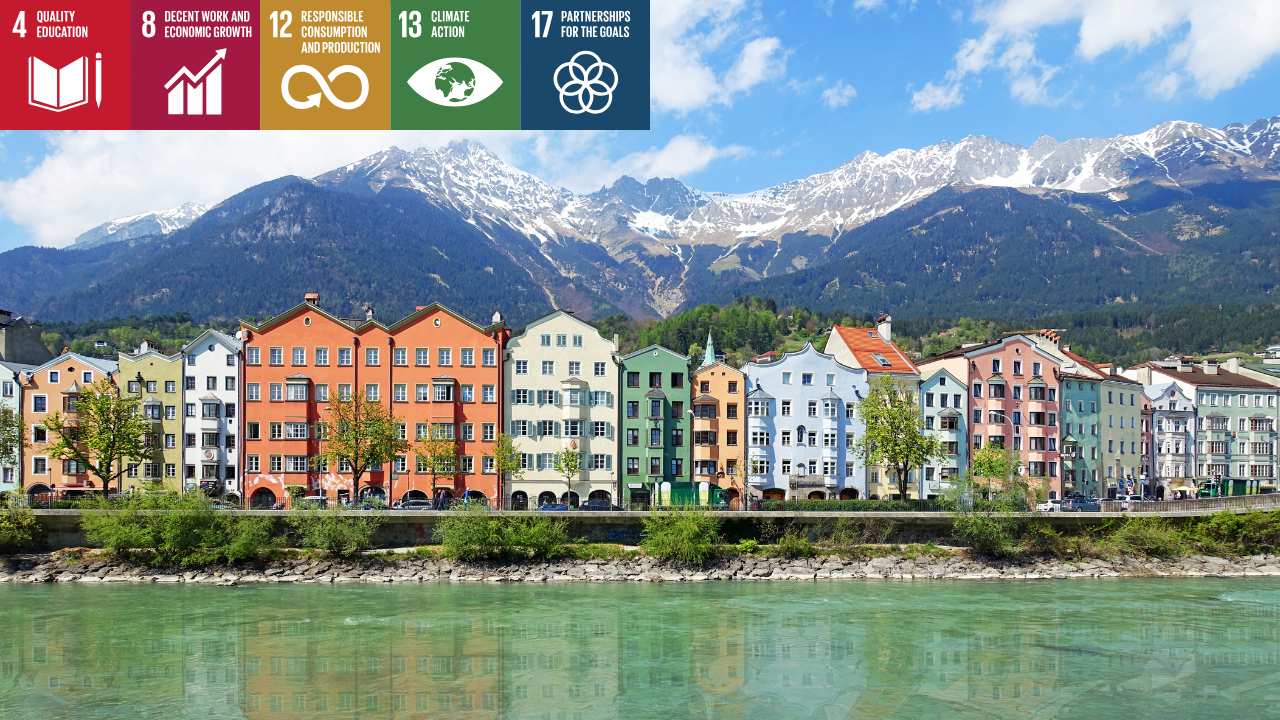
Sustainability at MCI is lived through everyday behavior and campus culture. Initiatives such as the Sustainability Week, the SDG Ambassador network, interdisciplinary research projects, and environmental improvements empower students and staff to contribute actively to a more sustainable future. These efforts support SDG 4 (Quality Education), SDG 8 (Decent Work and Economic Growth), SDG 12 (Responsible Consumption and Production), SDG 13 (Climate Action), and SDG 17 (Partnerships for the Goals), positioning MCI as a model for responsible higher education.
MCI’s key innovation is its systemic approach to embedding sustainability across the entire institution. Rather than limiting SDG content to specific courses, MCI aims to integrate sustainability into curricula across disciplines. As Regina explained: “One of the things we are about to do now is be more systemic about implementing the SDGs in the curriculum. So when you look at your syllabi, you will see those SDGs.”
Initiatives such as hosting the 2022 Responsible Management Education Research Conference and expanding Sustainability Week from a student idea into a campus-wide event are further examples. The SDG Ambassador program ensures sustainability expertise reaches every department. As Regina noted: “We also have a group of so-called SDG ambassadors, so they are colleagues from the different departments at MCI who are passionate about the subject, and they are really the connection for our center.”
Operational measures, including reducing plastic, improving recycling, and moving toward a paperless campus, translate sustainability into daily practice. Collectively, these measures form a replicable model for universities seeking to integrate sustainability in a holistic, impactful way.
MCI’s sustainability efforts are rooted in the belief that education can drive societal transformation. As a long-standing PRME (Principles for Responsible Management Education) signatory, MCI continuously evaluates its activities and aligns itself with global developments. Regina emphasized PRME’s influence: “Having been part of that network also means that we had to regularly report on our activities, so that really spurs you on also continually to improve, do new things, and connect with other universities and also businesses.”
This commitment fosters a culture in which sustainability is viewed as a shared responsibility across all disciplines, from engineering and business to health and the social sciences. Many initiatives, including the MCI Sustainability Week and new research projects, were sparked by student engagement, illustrating the mutual inspiration between MCI and its learners.
MCI’s impact is visible in its academic community, research activities, and regional partnerships. Students develop the ability to analyze global challenges through a combination of critical reflection and ethical awareness. As Regina noted: “There are lots of different ways of contributing to sustainable development.”
A culture of open dialogue encourages students and staff to question assumptions, challenge unsustainable practices, and take responsibility for their decisions. Research teams contribute to SDG-related progress through projects on circular economy models, social and health innovation, water and sanitation, renewable energy, and digital ethics and sustainability. Partnerships with international universities, businesses, and regional organizations extend MCI’s influence, while operational measures reinforce sustainable choices on campus.
Deeply integrating sustainability strengthens MCI’s profile and competitiveness. Institutions that prepare ethically aware, future-oriented graduates are increasingly attractive to students, employers, and partners. MCI actively monitors global policy developments to keep its programs aligned with emerging labor market demands, ensuring students gain competencies relevant to responsible leadership.
Sustainability enriches MCI’s institutional identity, which is rooted in entrepreneurial thinking and innovation, and builds trust among stakeholders. As Regina explained: “That’s where we are trying to take the DNA that we have and see how that fits into efforts to be more sustainable and to contribute to sustainable development, and I think that's where things can get quite exciting.”
Internal collaboration is strengthened through the SDG Ambassador network: “We have about 30 ambassadors, so that’s something that really helps also drive the agenda out into the different teams and departments.”
MCI generates social and environmental benefits that influence campus life and the broader region. Environmentally, eliminating plastic bottles, improving recycling, and promoting paperless workflows reduce waste and support responsible resource use. The climate team supports these initiatives: “We have a climate team […] so that there are six motivated people who […] try to really make the campus greener.”
Socially, MCI fosters critical thinking, ethical awareness, and responsible decision-making. Students are encouraged to challenge assumptions and initiate discussions, as Regina explained: “Asking difficult questions in classes. If you do marketing and there is no mention of Green Branding or Greenwashing and so on, why don’t you just raise your hand and […] trigger a discussion around that.”
One of MCI’s most impactful contributions is its emphasis on spreading sustainability through everyday conversations. Regina captured this vision: “For me, it's less about doing the big things; it's more about engaging people in your family, in your friend group, and so on into conversations that are about sustainability. […] I would say we have to create a virus of sustainability. That's how we can pass on the virus.”
Together, these efforts advance key SDGs while shaping graduates who are socially responsible and environmentally aware.
Get stories of positive business innovations from around the world delivered right to your inbox.
Regina Obexer, Head for the Center for Responsible Management & Social Impact
MCI – The Entrepreneurial School® is a leading higher education institution in Innsbruck, Austria. Founded in 1996 as a spin-off of the University of Innsbruck, it now hosts around 3,500 students across business, engineering, health, life, and social sciences. Known for its applied research and strong ties to industry and society, MCI coordinates its sustainability initiatives through the Centre for Responsible Management & Social Impact.