
Jordy Smeekens

Avans University of Applied Sciences
Janne Toonen


Keep this story going! Share below!
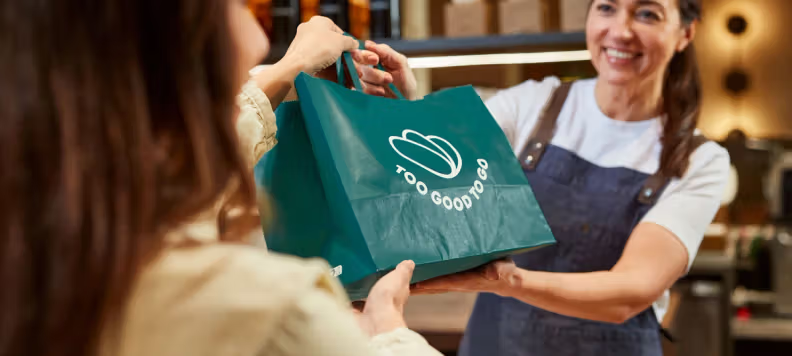
Too Good To Go is a social company that tackles food waste by connecting businesses with surplus food to consumers through a mobile app. Their innovative ''Magic Box'' solution allows users to purchase unsold food at reduced prices. Preventing it from being thrown away. This solution directly contributes to SDG 12 – Responsible Consumption and Production by reducing food waste, while also supporting SDG 13 – Climate Action by lowering CO2 emissions associated with wasted food. And also SDG 2 - Zero hunger. By making food cheaper and available for everyone.
Too Good To Go was founded in 2015 in Copenhagen Denmark. By Lucie Basch and her team. The company’s innovation is centered on a simple yet powerful idea: rescuing unsold food from restaurants, bakeries, supermarkets, and hotels and delivering it to consumers through the app. Users purchase a ''Magic Box'' of food at a fraction of its original cost, not knowing exactly what is inside Turning the rescue of surplus food into a sustainable and engaging experience.
The innovation solves multiple global challenges. By preventing food from being wasted. Too Good To Go reduces the energy, water, and resources used to produce food that would otherwise be thrown away. The company operates in over 15 countries, including the Netherlands and Denmark. This shows that this scalable model can be applied globally.
The process is simple yet effective: local businesses list their unsold items on the app, users reserve and pay for the box through their phones and then pick it up at the designated time. This system creates a win-win scenario: businesses reduce waste and recoup some costs. While consumers gain access to affordable, high quality food. By using technology, Too Good To Go makes sustainability easy businesses and consumers.
The inspiration for Too Good To Go came from founder Lucie Basch’s personal experience with seeing food wasted around her and realizing the scale of the problem globally. Lucie noticed that many restaurants and shops were throwing away perfectly good food simply because it could not be sold that day. She felt that this was not only a waste of resources but also an ethical issue, especially considering global hunger.
In an interview, Lucie shared, “I wanted to create a solution that was simple for both businesses and consumers. Saving food should be easy and rewarding for everyone involved.” Her motivation was driven by a belief that small changes, when scaled, can have a major positive impact on society and the environment.
The idea became more concrete when she realized that mobile technology could bridge the gap between surplus food and consumers. By creating a platform that allows users to rescue food easily. Too Good To Go combined technology, sustainability, and community engagement. This innovative approach shows that tackling large global problems like food waste, can start with simple, actionable steps. The company’s mission has inspired not only employees and partners but also other businesses to integrate sustainability into their daily operations.
Too Good To Go has had a measurable impact on food waste reduction and consumer awareness. Since its founding in 2015, the company has “rescued” millions of meals across more than 15 countries. By connecting businesses with surplus food to consumers. The company reduces the amount of food ending up in landfills, which in turn minimizes wasted water, energy, and other resources used in food production.
Short-term effects include immediate reductions in daily food waste for participating businesses, allowing them to save money and reduce disposal costs. Consumers gain access to affordable food while becoming more aware of the environmental impact of waste. Long-term effects are seen at a systemic level: Too Good To Go is influencing cultural attitudes toward food consumption and inspiring businesses to adopt more sustainable practices.
The innovation has also encouraged collaboration among stakeholders, including restaurants, supermarkets, and local governments. By creating a scalable and replicable model. Too Good To Go shows how technology-driven social companies can generate important changes, contributing to a more sustainable global food system
Because Too Good To Go developed an innovative platform to reduce food waste, it has strengthened its business operations and growth potential. The app has attracted millions of active users, generating consistent revenue through commission fees on each “Magic Box” transaction. This financial model allows the company to reinvest in technology, marketing, and expansion into new countries.
Employees benefit from working in a purpose-driven organization, which increases engagement, satisfaction, and retention. The company’s mission driven approach also attracts talent who are passionate about sustainability and social impact. Furthermore, businesses that partner with Too Good To Go report improved brand reputation and customer loyalty because they are seen as environmentally responsible. Opening doors to long-term collaborations and new market opportunities.
Too Good To Go’s innovation has also lead into new services and partnerships. Including campaigns with governments and NGOs to further reduce food waste at the national level. The company has positioned itself as a leader in the sustainability sector by increasing credibility with investors and partners. And enabling opportunities for expansion into additional markets worldwide.
Too Good To Go directly addresses global challenges. particularly SDG 12 – Responsible Consumption and Production and SDG 13 – Climate Action but also SDG 2- sero hunger. By rescuing food that would otherwise be wasted. the company reduces water and energy, and prevents unnecessary resource consumption. Each meal saved represents a reduction in environmental impact. demonstrating a clear connection between business innovation and societal benefit.
Society benefits in several ways. Consumers gain access to affordable and high-quality food. which can be especially valuable for lower-income households. Businesses participating in the program gain financial savings and strengthen their corporate social responsibility profile.
The innovation also has long term effects. By demonstrating a scalable model for reducing food waste, Too Good To Go influences policy discussions. And also inspires other social companies, and encourages sustainable across all industries. Collectively, these outcomes contribute to a more sustainable global food system. showing that socially minded business models can generate both environmental, socially and economic benefits.
Get stories of positive business innovations from around the world delivered right to your inbox.
Too Good To Go is a social company founded in 2015 in Copenhagen, Denmark, that fights food waste. The company connects businesses with surplus food such as restaurants, bakeries, and supermarkets to consumers through its app. Users can purchase “Magic Boxes” of unsold food at a reduced price, saving it from being thrown away. Too Good To Go operates in over 15 countries and aims to create a more sustainable food system while raising awareness about food waste.