

Raiti Adarsh
Achal Jain
Aarthi Venkatesh
KHUSHI GUPTA
Shravan Shetty

Goa Institute of Management

Divya Singhal


Keep this story going! Share below!
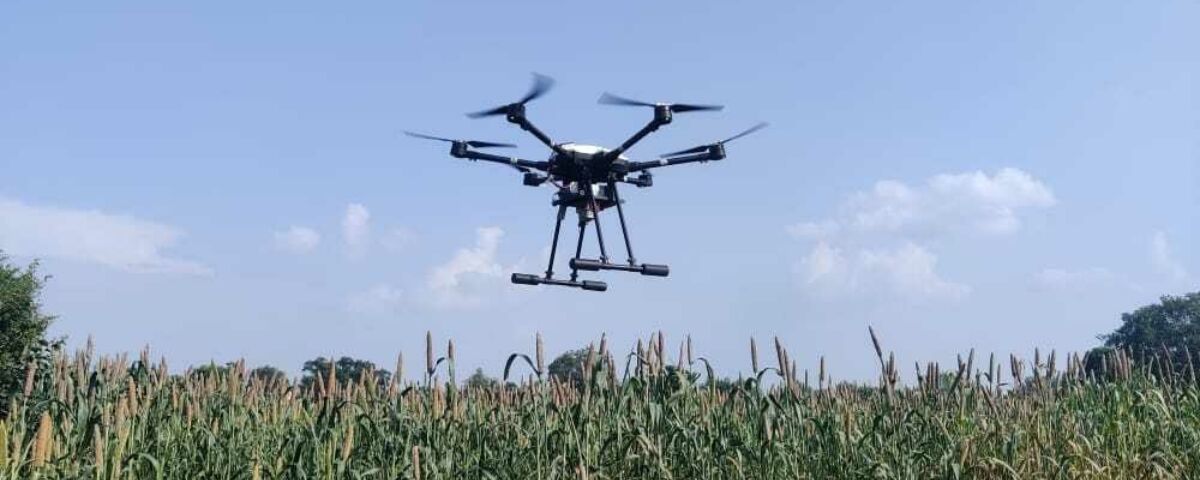
In an agrarian economy like India, where 46% of the population is actively involved in agriculture, approximately 22% still live below the poverty line. Innovations like BharatRohan aim to solve this problem using new-age technology. BharatRohan is a drone-based agri-tech start-up with a mission to revolutionize agriculture into a dignified, sustainable livelihood for future generations and to make cutting-edge technology accessible in rural markets, empowering farmers with tools for resilient, chemical residue-free farming. It uses hyperspectral imaging to detect nutrient deficiencies or pest issues even before they become visible to the human eye. These result in higher yields, lower chemical usage, and lower input costs, making the crop healthier. Here are the major SDGs that BharatRohan aims to achieve:
The idea for the hyperspectral drone came to the founders, Amandeep Panwar and Rishabh Choudhary, while they were experimenting with drones in Barabhanki, a village in the Indian state of Uttar Pradesh. Upon seeing the drones, a small group of farmers, out of curiosity, asked whether this drone technology could benefit farmers. This curiosity had a profound impact on the founders, which led them to reach out to manufacturers in the US and Belgium to develop a small, custom hyperspectral imaging device that could be attached to a drone.
UAV-based hyperspectral imaging uses 140+ colour bands to record the most minor physiological and phenological changes in crops in every survey that has helped farmers with plant health status, nutrient management, pest and disease management, water management, acreage estimation, and identify major problems with their crops way before they were identifiable by human eyes and hence helped the farmers take corrective measures, saving the crops. These models would further create spectral libraries for each crop and undertake comparative analyses of spectral variations and data points. The variations enable a clear assessment of crop health and the intensity of pest and disease, water stress, and nutrient deficiency. India's diverse languages made sending real-time data difficult, but with data analytics, BharatRohan would deliver actionable insights and advisories to farmers in their local language via WhatsApp, which is ubiquitous in India.
This technology is helping create a better world by reducing the haphazard use of pesticides and other chemicals on farm fields, which often harm the flora and fauna of surrounding areas. An increase in crop yields on the same land due to this technology has led many farmers to earn more income than they do in traditional farming, helping them climb the economic ladder. This sustainable production pattern has contributed to the good health and well-being of its consumers. Hence, this innovation has contributed to:
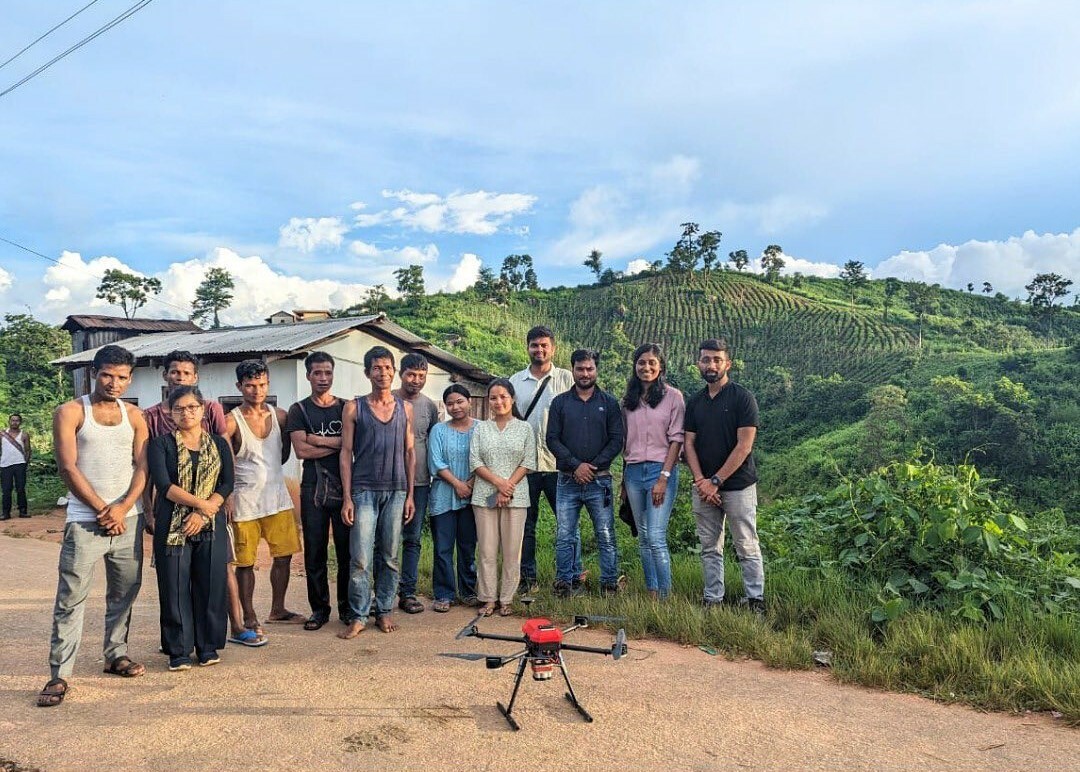
Nurturing empathy, technology, and impact for a revitalized Agri Value Chain
The founders of BharatRohan, Amandeep Panwar and Rishabh Choudhary, were inspired by a hands-on, problem-first exposure to farming challenges while they were still engineering students. Their motivation did not come from a boardroom strategy. "The idea actually began when our founders… were engineering students experimenting with drones over farms in Barabanki," as said in the interview. This early experimentation sparked curiosity among local farmers, who began asking whether drones could help them with their farming. These fundamental questions from farmers became the trigger point for innovation: "Farmers used to become curious… they used to ask if a drone could understand their crops better."
What truly inspired the founders was the realization that farmers were often reacting too late to crop problems. Traditional farming methods detect stress only when visible symptoms appear, by which time the damage has already started. The founders saw an opportunity to shift agriculture from reactive to preventive decision-making using advanced sensing. As explained in the interview, hyperspectral imaging allows detection of crop stress before it becomes visible to the human eye: "This allows us to detect crop stress, nutrient deficiencies, or pest issues even before they become visible to human eyes."
Their inspiration was also shaped by exposure to cutting-edge science. Learning that hyperspectral imaging is used in space missions like Chandrayaan reinforced their belief that high-end technology could be repurposed for grassroots impact: "Hyperspectral imaging [is] even used in space missions like Chandrayaan… they decided that they can use this technology for agriculture." The driving force the founders felt was the idea that such powerful technology should not remain confined to laboratories or satellites. Still, they should be adapted to address the everyday problems farmers on the ground face.
Bharat Rohan’s innovation demonstrates how technology can create real change when it is designed around people’s everyday challenges. By using drone-based hyperspectral imaging, the company helps farmers understand what is happening inside their crops before problems become visible. Traditionally, farmers take action only after noticing damage, by which time losses have already begun. Bharat Rohan changes this approach by providing farmers with early insights and simple guidance via WhatsApp messages in local languages, enabling them to act at the right time and make informed decisions about their farms.
In the short term, this innovation has made farming more efficient and less risky. Farmers can use fertilizers and pesticides only when necessary, reducing costs and preventing excessive chemical use. During the interview, Ms. Vaishali shares the experience of a farmer from Barabanki who experienced a 30–35 percent increase in crop yield while reducing input costs by about 30 percent. Such outcomes show that the innovation does not just introduce new technology but directly improves farmers’ livelihoods. The company further supports farmers by providing bio-inputs and precision spraying services, ensuring they have the knowledge and tools needed to implement sustainable practices effectively.
Over time, the impact extends beyond individual farmers to the broader agricultural ecosystem. Bharat Rohan’s vision, reflected on its official website, focuses on making agriculture more sustainable, transparent, and economically rewarding. Through its traceability system, buyers can track produce back to the farm and verify how it was grown, helping farmers access better markets and fairer prices. The evidence of impact is unmistakably present across all sectors, affecting individuals, businesses, and consumers alike. Making possible not only improved yields and incomes but also in changing mindsets. Farmers who were initially hesitant to adopt new technology began trusting it after seeing tangible results in their fields. More importantly, Bharat Rohan helps shift the narrative around agriculture by showing that farmers can be empowered through innovation rather than left behind by it. By combining technology with accessibility and empathy, the company creates lasting economic, environmental, and social value, contributing to a more sustainable future for agriculture.
With BharatRohan’s evolution into a vertically integrated agri-solutions company, using hyperspectral imaging for early crop stress detection, setting up Pragati Kendras for ground-level support for farmers, and providing end-to-end farm-to-pack traceability through SourceAssure, the number of farmers under its network escalated from 2,714 to 12,729, and revenues close to 4x to Rs. 2,817 Lakhs in FY25. Precision-guided farming with reduced chemical use enabled farmers to demand higher prices for residue-free crops, demonstrating that sustainability and financial success can truly complement each other. Small and marginal farmers also benefited, with individual farmers reporting 30-35% increases in yields and 30% reductions in input costs, with advisories sent through WhatsApp in regional languages to ensure that even small farmers could benefit from the knowledge.
The Pragati Kendras have created an ecosystem with the true potential to increase farmer incomes by 25-35%, where sustainability is not merely a byproduct for the environment but a direct reward for the people who are actually doing the work. This effect becomes most apparent when you hear about Atyendra Kumar Verma from Barabanki, about whom we came after interviewing the BharatRohan team. With accurate stress maps, nutrient notifications, and advice on biodegradable measures, Atyendra cut back on fertilizer and pesticide applications altogether, using them only when and where they were actually needed. His revenue increased not only from better harvests but also from reducing waste. It’s a very straightforward yet very effective concept, and it is what the BharatRohan team is attempting to scale up: sustainability and profitability feeding each other, one farmer at a time.
What makes this so thrilling is that the BharatRohan team has developed something that transcends agriculture by a long shot. The extensive R&D expertise in hyperspectral imaging has led to the development of a technology platform that can be applied to other sectors. The same drone-borne sensors that measure crop stress are now being explored to enhance solar panel efficiency, map mining resources, and track deforestation. At the same time, current proofs of concept in the pharmaceutical industry use spectral imaging to detect counterfeit drugs.
BharatRohan’s innovation has primarily benefited small and marginal farmers, especially in places like Barabanki, where the team first began testing its solution. What really stands out is how they use drone-based hyperspectral imaging to detect crop stress, nutrient gaps, and pest risks even before farmers can see any visible signs. These timely, systemic alerts occur early in the crop cycle, so farmers can act in time rather than react after damage has occurred. By converting complex sensor data into simple WhatsApp messages in local languages, the company has made advanced technology something farmers can actually use daily. Farmers we spoke with reported healthier crops, lower chemical use, and better market prices, demonstrating how early intervention can directly improve incomes and stability.
From an environmental perspective, the most significant benefit is the reduced overuse of chemicals and water. Instead of spraying fertilizers and pesticides everywhere, farmers now apply them only where needed. BharatRohan also supports this with bio-inputs and targeted spraying services, which help reduce chemical runoff and unnecessary water use. Over time, this reduces soil and water pollution and makes farming practices more sustainable, without hurting crop yields.
The impact also goes beyond farming practices through traceability and procurement. With lab testing and clear records of the inputs used, buyers can trust the quality of the produce, and farmers can assess and access better-paying markets, creating a win–win situation. The consumers get safer food, farmers earn more stable incomes, and sustainable farming becomes financially rewarding, not just environmentally responsible.
Get stories of positive business innovations from around the world delivered right to your inbox.
Vaishali Sharma, Visual Communications Lead

BharatRohan Airborne Innovations Ltd. is an Indian agritech company that helps farmers and agri-enterprises improve productivity using drone-based sensing, advanced imaging, and data analytics. The company provides crop monitoring, advisory, and quality/traceability solutions, and connects farmers to inputs and markets across the agriculture value chain. Its technology-led services aim to boost yields, reduce input waste, and enable more sustainable, profitable farming at scale.